
What Does Melatonin Actually Do?
Melatonin is a hormone produced by the pineal gland, primarily in response to darkness. Its central role is signalling to the body that it is time to sleep — it does not knock you out like a sedative, but rather tells your circadian clock that night has arrived. Endogenous melatonin rises gradually in the evening, peaks during the early hours of sleep, and falls by morning.
Melatonin for beginners is often misunderstood: it is a timing signal, not a sleeping pill. This distinction matters because it affects how you should use it.
How to Start: Timing, Dose, and Expectations
Timing Is More Important Than Dose
Melatonin is most effective when taken close to your target bedtime and at the same time each night, because its benefit is circadian — it helps shift your sleep phase.
- Standard timing: 30–60 minutes before your intended sleep time
- For circadian phase shifting (jet lag, shift work): the timing may differ — discuss with a doctor or sleep specialist
Start with a Low Dose
A common mistake among beginners is taking too much. Research suggests that low doses are effective for sleep onset and circadian phase effects, and that higher doses do not linearly produce better sleep. Starting with a low dose is generally the evidence-based approach (Brzezinski et al., 2005).
Practical advice: Begin with the lowest available dose — typically 0.5–1 mg. Only increase if clearly insufficient after a week of consistent use at the correct timing.
What to Expect in the First Week
- You may feel mildly drowsy 30–60 minutes after taking melatonin
- Sleep onset time may shorten, particularly if your natural sleep drive is already present
- Some people notice no effect for the first few nights — this is normal with low doses
- Do not take melatonin and then stay awake with bright screens; this undermines its signal
The Estonian and Nordic Winter Context
In Estonia and other Nordic countries, winter months bring dramatic reductions in daylight — as few as six hours of sunlight per day. This can disrupt circadian rhythms and delay the natural melatonin signal. Many Estonians find sleep quality deteriorates in November–February. Evening light hygiene (dimming screens and lights 1–2 hours before bed) combined with low-dose melatonin supplementation can be helpful during this period.
Common Mistakes
Taking Too High a Dose
The supplement market offers melatonin in doses from 0.5 mg to 10 mg. The pharmacological doses of 5–10 mg were studied for specific clinical applications, not as standard sleep aids. For typical sleep onset support, there is good evidence that doses in the lower range are sufficient (Brzezinski et al., 2005).
Mistake: Buying a 5–10 mg tablet and taking it thinking more is better. This can cause next-morning grogginess, vivid dreams, and over time may blunt the sensitivity of melatonin receptors.
Using Melatonin as a Long-Term Standalone Solution
Melatonin addresses circadian timing and mild sleep onset issues. It does not treat insomnia disorder, sleep apnoea, restless legs syndrome, or sleep disruption caused by anxiety or depression. If sleep problems persist beyond 2–4 weeks despite good sleep hygiene and melatonin use, consult a doctor.
Inconsistent Timing
Taking melatonin at different times each night reduces its circadian benefit. Consistency — same time, same routine — is essential for maximum effect.
Bright Light After Dosing
Blue light from phones and screens suppresses melatonin. Taking melatonin and then continuing to use a bright phone screen for an hour cancels out its benefit. Dim your screens or use night-mode settings.
Choosing a Product
Key things to consider:
- Dose: Start with 0.5–1 mg if possible; if only 1–3 mg products are available, they are also reasonable starting points
- Form: Sublingual tablets or liquid forms may act faster; standard tablets release more gradually
- Additional ingredients: Some products include L-theanine, GABA, or herbal extracts (lemon balm, valerian) — these can be synergistic but add complexity
- Quality: Choose products from reputable brands with clear labelling
At maxfit.ee, the melatonin category includes ICONFIT Capsules Melatonin N90, NOW Melatonin 1mg Complex 100tabs (a low-dose option), 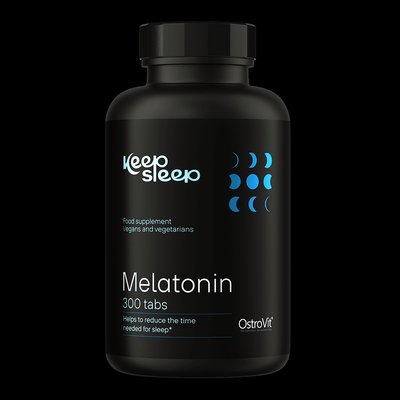 OstroVit Keep Sleep Melatonin€8.90 In stock 300tabs, and BIOTECHUSA Melatonin 90tab.
  ICONFIT Capsules Good Sleep N90€12.90 In stock combines melatonin with L-theanine for a multi-ingredient approach.
FAQ
Is melatonin habit-forming?
Melatonin is not habit-forming in the pharmacological sense. It does not create physical dependence or withdrawal effects. However, relying on it nightly without addressing underlying sleep hygiene issues means you may not fully resolve the root cause of poor sleep.
Can I take melatonin every night?
Short-term use (days to weeks) is well tolerated and commonly practised for jet lag or circadian adjustment. For nightly use over months, evidence is more limited but no serious safety signals have emerged at low doses. Periodic breaks are a common precautionary approach. Consult a doctor for long-term nightly use.
Will melatonin make me groggy the next morning?
At low doses taken early enough in the evening, next-morning grogginess is uncommon. It is more likely with high doses (5–10 mg) or if taken too late at night. Choosing a lower dose and taking it earlier (at least 7–8 hours before you need to wake) minimises this risk.
References
Brzezinski, A., Vangel, M. G., Wurtman, R. J., Norrie, G., Zhdanova, I., Ben-Shushan, A., & Ford, I. (2005). Effects of exogenous melatonin on sleep: a meta-analysis. Sleep Medicine Reviews, 9(1), 41-50. https://pubmed.ncbi.nlm.nih.gov/15649737/
Zhdanova, I. V., Wurtman, R. J., Morabito, C., Piotrovska, V. R., & Lynch, H. J. (1996). Effects of low oral doses of melatonin, given 2-4 hours before habitual bedtime, on sleep in normal young humans. Sleep, 19(5), 423-431. https://pubmed.ncbi.nlm.nih.gov/8843534/



