What Is L-Arginine?
L-arginine is a conditionally essential amino acid that the body can synthesize, but during intense physical exertion, endogenous production may not keep pace with demand. Dietary sources include legumes, nuts, seafood, and meat.
L-arginine's primary relevance for athletic performance is its role as the main substrate for nitric oxide (NO) synthesis. The enzyme nitric oxide synthase (NOS) converts arginine into nitric oxide and citrulline. Nitric oxide is a potent vasodilator — it relaxes blood vessel walls, widening them and allowing greater blood flow to working muscles (Böger, 2007).
Arginine's Roles Beyond the Pump
While most people associate arginine with nitric oxide, this amino acid has broader functions:
- Urea cycle: arginine is critical for nitrogen detoxification, converting toxic ammonium to urea for excretion
- Creatine synthesis precursor: creatine is synthesized from arginine, glycine, and methionine
- Growth hormone secretion: intravenous arginine stimulates growth hormone — the oral supplementation effect is modest but real
- Immune function: arginine is an important substrate for immune cells (macrophages, T-cells)
L-Arginine vs L-Citrulline: Which Is Better?
This is a common question, and the answer isn't black and white:
| Property | L-Arginine | L-Citrulline |
|---|---|---|
| Oral bioavailability | Lower (~68%) | High |
| Plasma arginine elevation | Moderate | High (indirect) |
| Optimal dose | 3–6 g | 6–8 g (malate 2:1) |
| GI tolerance | Poor at high doses | Good |
| Research support for sport | Moderate | Stronger |
Citrulline produces higher plasma arginine levels because of pharmacokinetics: oral arginine is substantially metabolized in the gut and liver before reaching systemic circulation. Citrulline bypasses this first-pass metabolism and is converted to arginine in the kidneys, providing a more sustained and higher arginine buffer (Curis et al., 2007).
This does not make L-arginine useless — but for high-intensity pre-workout use, citrulline is more efficient. L-arginine is valuable in combinations, at steady low-dose supplementation, and for goals like growth hormone support.
Athletic Benefits — What Research Shows
Blood Flow and Pump
A study on cardiovascular health and athletic performance found that 6 g of L-arginine before endurance training significantly elevated plasma arginine and nitric oxide metabolites, improving tolerance of repeated high-intensity bouts (Schaefer et al., 2002).
Growth Hormone Stimulation
Combined arginine and lysine (1.5–3 g each) increased resting growth hormone levels versus placebo — though the effect was modest (Isidori et al., 1981).
Aerobic Capacity
A meta-analysis of 12 trials found that arginine supplementation (2–20 g/day) significantly increased VO₂max values (Álvares et al., 2011), suggesting improved oxygen transport efficiency.
Dosing
| Goal | Recommended dose | Timing |
|---|---|---|
| General NO support | 2–3 g | With meals |
| Pre-workout pump | 3–6 g | 30–60 min before training |
| Growth hormone support (before sleep) | 2–3 g | Before bed |
At maxfit.ee you'll find several quality arginine options. MST L-Arginine 120caps is a clean, convenient capsule. ICONFIT L-Arginine 90caps is an Estonian sports brand product with excellent value. NOW L-Arginine 500mg 100 veg. caps. offers a plant-based capsule for precise dosing. For a citrulline and arginine combination in one product, MST Amino Pump L-Citrulline + L-Arginine 60caps is an excellent choice. For flexible bulk powder use, 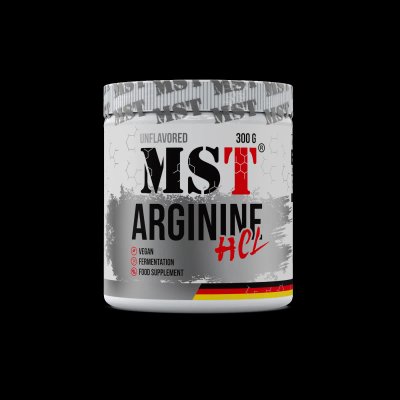 MST Arginine HCL 300g Unflavored€20.90 In stock works well.
Browse all options in the pre-workout supplements category at maxfit.ee.
Smart Combinations
- L-citrulline malate — together they cover the NO synthesis precursor pathway, delivering better and more sustained NO production
- Creatine — two distinct mechanisms: arginine for blood flow, creatine for ATP replenishment
- Beta-alanine — broad pre-workout trio: arginine, citrulline/beta-alanine, caffeine
- ZMA (zinc + magnesium + B6) — supports growth hormone and testosterone overnight, which synergizes with arginine's hormonal effects
Safety and Side Effects
L-arginine is well tolerated at standard doses (up to 9 g/day). Larger doses (>10 g at once) may cause:
- Diarrhea
- Stomach cramps
- Nausea
People with a history of herpes virus infection (HSV-1 or HSV-2) should note that high arginine intake may stimulate viral replication — in this group, adding L-lysine is advisable. Those taking blood pressure medications should exercise caution, as arginine may further lower blood pressure.
Conclusion
L-arginine is a classic nitric oxide precursor supporting blood flow, muscle pump, and multiple body functions. While citrulline is more effective at elevating arginine plasma levels when taken orally, arginine has a clear place — especially in combinations, at steady low doses for ongoing support, and for growth hormone stimulation before sleep. Choose based on your specific training goals.
FAQ
Should I choose arginine or citrulline?
For specific training effects (pump, fatigue delay), citrulline malate is generally the more effective choice for pre-workout use. However, L-arginine is still valuable for broader NO support goals and works especially well in combination with citrulline.
Does arginine actually raise growth hormone?
With oral supplementation, the growth hormone stimulation effect is modest — significantly smaller than with IV administration used in most studies. Arginine before sleep may support the natural overnight growth hormone peak, but this is not comparable to pharmacological methods.
Can arginine support cardiovascular health?
Some studies show arginine may support endothelial function and blood pressure in clinical situations (e.g., endothelial dysfunction). In healthy individuals, the effect is more modest and should not replace medical approaches.
References
- Böger, R. H. (2007). The pharmacodynamics of L-arginine. Journal of Nutrition, 137(6), 1650S–1655S.
- Curis, E., Nicolis, I., Moinard, C., Osowska, S., Zerrouk, N., Bénazeth, S., & Cynober, L. (2007). Almost all about citrulline in mammals. Amino Acids, 29(3), 177–205.
- Schaefer, A., Piquard, F., Geny, B., Doutreleau, S., Lampert, E., Mettauer, B., & Lonsdorfer, J. (2002). L-arginine reduces exercise-induced increase in plasma lactate and ammonia. International Journal of Sports Medicine, 23(6), 403–407.
- Álvares, T. S., Meirelles, C. M., Bhambhani, Y. N., Paschoalin, V. M. F., & Gomes, P. S. C. (2011). L-arginine as a potential ergogenic aid in healthy subjects. Sports Medicine, 41(3), 233–248.



