When to Take Iron: Optimal Timing
Iron is one of the most timing-sensitive supplements you can take. Small changes in how and when you take it can meaningfully change how much your body actually absorbs. Whether you are correcting a deficiency or maintaining adequate levels as an active person, these timing principles will help you get the most from your iron supplement.
With or Without Food?
Iron is absorbed most efficiently on an empty stomach. When taken without food, non-haem iron (the form found in most supplements) has better access to intestinal transport proteins and is not competing with inhibitors in food.
However, many people find that iron taken on an empty stomach causes nausea, stomach cramps, or constipation. If this is you, taking iron with a small, low-inhibitor meal is a practical compromise. Foods to avoid at the same time as iron include:
- Dairy (contains calcium, which competes with iron for absorption)
- Eggs
- High-fibre cereals and bran
- Coffee and tea (contain tannins and polyphenols that bind iron)
- Legumes (contain phytates)
A small piece of fruit, plain rice, or a light protein source is a better food pairing if you need to take iron with something in your stomach.
At maxfit.ee, you will find iron supplements including ICONFIT Capsules Ferrum + Vitamin C 90caps – this product already includes vitamin C, which actively enhances iron absorption. NOW Iron 36mg Ferrochel 90caps uses a chelated bisglycinate form that is generally gentler on the stomach, as does 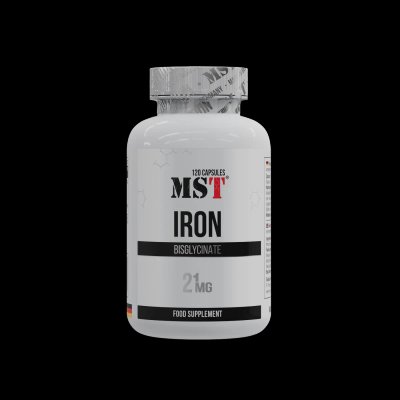 MST Iron bisglycinate€19.90 In stock 21mg 120caps.
Time of Day and Training
Morning is often recommended for iron supplementation because stomach acid tends to be more active and the day's dietary inhibitors have not yet accumulated. Many people find it easiest to build a consistent morning routine.
Around training: athletes, particularly endurance athletes, have higher iron losses through sweat, foot-strike haemolysis (in runners), and inflammation. Iron is not a performance supplement in the acute sense, but maintaining adequate status is important for oxygen transport via haemoglobin. A study of female athletes found that iron deficiency without anaemia still impaired maximal aerobic capacity and exercise performance (Brutsaert et al., 2003).
There is no specific evidence that iron taken immediately before or after exercise is more effective than iron taken at other times. Aim for a consistent daily time that you can sustain.
Split Doses vs Single Dose
For most iron supplements, a single daily dose is standard and well-supported by research. Some evidence suggests that alternate-day dosing (rather than daily) may produce comparable absorption for some individuals, as this avoids the hepcidin-mediated absorption inhibition that occurs in the hours following a dose (Moretti et al., 2015). Hepcidin is a hormone that reduces iron absorption after the body detects a recent iron load.
Practical takeaway:
- Single daily dose works well for most people.
- If you experience poor tolerance or unclear benefit with daily dosing, discuss alternate-day dosing with a healthcare professional.
- Splitting into two daily doses is generally not recommended, as the afternoon/evening dose would face rising hepcidin levels from the morning dose.
Interactions Affecting Timing
Calcium: one of the most important interactions to manage. Calcium directly inhibits iron absorption. Keep calcium supplements at least two hours away from iron (Hallberg et al., 2000).
Vitamin C (ascorbic acid): enhances non-haem iron absorption by reducing Fe3+ to the more absorbable Fe2+ form and forming a chelate that keeps iron soluble in the gut. Taking vitamin C at the same time as iron is beneficial. Products like ICONFIT Capsules Ferrum + Vitamin C 90caps already incorporate this combination.
Zinc and magnesium: high doses of these minerals can also compete with iron at shared absorption sites. Avoid stacking multiple high-dose minerals in the same sitting.
Tannins in tea and coffee: these polyphenols strongly inhibit non-haem iron absorption. Wait at least one hour after drinking tea or coffee before taking iron.
Proton pump inhibitors and antacids: reduce stomach acid, which is needed to convert dietary Fe3+ to the absorbable Fe2+ form. If you take acid-reducing medications, chelated iron forms (bisglycinate) are better absorbed as they do not require acid for solubilisation.
Levothyroxine and some antibiotics: can interact with iron. Separate by at least two hours and follow your prescriber's guidance.
Practical Schedule
| Time | Action |
|---|---|
| Morning (ideally on empty stomach or with small low-inhibitor snack) | Iron supplement with a glass of water or diluted juice (vitamin C source) |
| Same morning | Wait at least 1 hour before coffee or tea |
| At least 2 hours after iron | Calcium supplement (if taken separately) |
| Avoid at the same time | Dairy, eggs, bran cereals, antacids |
FAQ
Why does iron make my stomach hurt?
Ferrous sulphate and ferric forms can irritate the gut lining. Chelated forms such as iron bisglycinate (found in MST Iron bisglycinate 21mg 120caps and NOW Iron 36mg Ferrochel 90caps) are associated with fewer gastrointestinal side effects (Tolkien et al., 2015). Taking iron with a small amount of food also reduces irritation.
Can I take iron every other day?
Alternate-day dosing may be as effective as daily dosing for some people while reducing side effects, because hepcidin levels return to baseline by the following morning. This is an emerging approach; discuss it with your doctor, particularly if you are managing diagnosed iron deficiency anaemia.
How long before I feel the benefit of iron supplementation?
If you are genuinely deficient, it typically takes several weeks of consistent supplementation before haemoglobin levels improve noticeably. Full iron store repletion can take three to six months. Do not stop supplementation as soon as you feel better without checking your levels.
References
Brutsaert, T. D., Hernandez-Cordero, S., Rivera, J., Viola, T., Hughes, G., & Haas, J. D. (2003). Iron supplementation improves progressive fatigue resistance during dynamic knee extensor exercise in iron-depleted, nonanemic women. American Journal of Clinical Nutrition, 77(2), 441–448. https://pubmed.ncbi.nlm.nih.gov/12540406/
Moretti, D., Goede, J. S., Zeder, C., Jiskra, M., Chatzinakou, V., Tjalsma, H., Melse-Boonstra, A., Brittenham, G., Swinkels, D. W., & Zimmermann, M. B. (2015). Oral iron supplements increase hepcidin and decrease iron absorption from daily or twice-daily doses in iron-depleted young women. Blood, 126(17), 1981–1989. https://pubmed.ncbi.nlm.nih.gov/26289639/
Tolkien, Z., Stecher, L., Mander, A. P., Pereira, D. I., & Powell, J. J. (2015). Ferrous sulfate supplementation causes significant gastrointestinal side-effects in adults: a systematic review and meta-analysis. PLOS ONE, 10(2), e0117383. https://pubmed.ncbi.nlm.nih.gov/25700159/
Hallberg, L., Brune, M., Erlandsson, M., Sandberg, A. S., & Rossander-Hulten, L. (2000). Calcium: effect of different amounts on nonheme- and heme-iron absorption in humans. American Journal of Clinical Nutrition, 53(1), 112–119.



