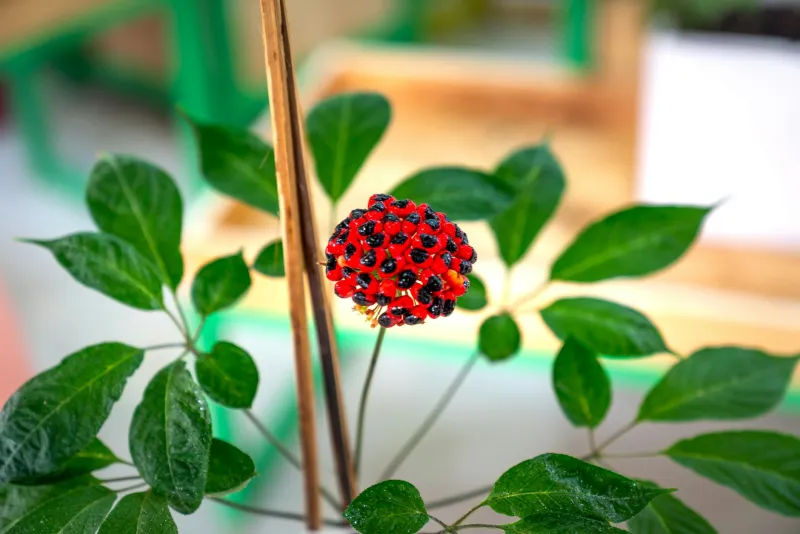
Ginseng Dosage: How Much to Take (Evidence-Based)
Ginseng is one of the most-studied adaptogenic herbs in the world, with a research record spanning over five decades. When people ask about ginseng dosage, they most often mean Panax ginseng (Asian ginseng), though Panax quinquefolius (American ginseng) and Eleutherococcus senticosus (Siberian ginseng, which is botanically distinct) are also in common use. This guide focuses on Panax ginseng, where the evidence is strongest.
What Makes Panax Ginseng Bioactive
The primary bioactive compounds in Panax ginseng are ginsenosides — a family of triterpenoid saponins unique to this genus. More than 40 ginsenosides have been identified; Rb1, Rg1, Re, and Rd are among the most studied. They modulate multiple systems: the HPA (hypothalamic-pituitary-adrenal) axis, nitric oxide signalling, and neurotransmitter pathways.
Standardised extracts are typically expressed as a percentage of ginsenosides — commonly 4–7% ginsenosides by dry weight, though higher-standardised preparations exist.
Studied Effective Dose Ranges
The most studied dose range for cognitive and energy outcomes is 200–400 mg per day of a standardised Panax ginseng extract (typically 4–7% ginsenosides). A double-blind, placebo-controlled study by Ellis and Reddy (2002) found that 200 mg daily of a standardised Panax ginseng extract (G115) improved working memory and mood in healthy middle-aged adults. A systematic review by Geng et al. (2010) identified improvements in cognitive performance across multiple trials, with most using 200–400 mg daily.
For athletic performance, doses of 200–400 mg per day of standardised extract have been used in trials examining VO₂ max and perceived exertion, though results are mixed and the effect sizes are modest compared with caffeine.
For dry root preparations (not standardised for ginsenosides), traditional and monograph-aligned doses range from 1–2 g per day, up to 3 g per day for short-term intensive use.
Dose by Goal
| Goal | Daily Dose (Standardised Extract) | Notes |
|---|---|---|
| Cognitive support / mental fatigue | 200 mg | Most-studied dose for acute cognitive tasks |
| General adaptogenic support | 200–400 mg | Consistent with most positive RCT data |
| Energy and physical performance | 200–400 mg | Evidence mixed; start at lower end |
Body weight is not a primary dosing variable in the published Panax ginseng literature.
Upper Limits and EFSA Guidance
There is no formal EFSA tolerable upper intake level specifically for Panax ginseng as a supplement. The European Medicines Agency (EMA) Community Herbal Monograph for Panax ginseng root (2014) supports traditional use at doses providing up to 2 g dried root equivalent per day for short periods.
Key safety considerations:
- Ginseng Abuse Syndrome: Originally described with very high doses (>3 g/day for prolonged periods) — symptoms include hypertension, oedema, and insomnia. Not typically observed at standard supplement doses.
- Drug interactions: Ginseng may interact with warfarin, some antidepressants (MAOIs), and hypoglycaemic agents. Those on these medications should consult a healthcare professional.
- Stimulant effects: Insomnia and restlessness have been reported; evening dosing is generally not recommended.
Timing Relative to Dose
For cognitive and energy support, ginseng is most commonly taken in the morning, often with or just after breakfast. This timing:
- Avoids potential sleep disruption from mild stimulant properties
- Aligns with the natural cortisol awakening response, when cognitive demands are typically highest
- Matches the design of most published trials (morning administration)
For chronic adaptogenic use, twice-daily dosing (morning and early afternoon) is sometimes used and appears well-tolerated in trials.
Practical Protocol
- Start with 200 mg of a standardised extract (4–7% ginsenosides) once daily in the morning.
- Assess after 2–4 weeks before increasing.
- Cycle on/off: most traditional use and several trial protocols suggest using for 8–12 weeks, then taking 2–4 weeks off before resuming.
- Avoid combining with stimulants (high-dose caffeine) at the same time unless experienced with both.
At maxfit.ee you can find OstroVit Panax Ginseng VEGE 60caps — a vegan-certified Panax ginseng supplement available in the ženšeni section.
FAQ
How long does it take for ginseng to work?
Some cognitive effects (alertness, reaction time) may be noticed within a single dose. Adaptogenic effects — stress resilience, sustained energy — are generally reported after 4–8 weeks of consistent use.
Is Panax ginseng the same as Siberian ginseng?
No. Siberian ginseng (Eleutherococcus senticosus) is a different plant with different bioactives (eleutherosides, not ginsenosides). They are both classified as adaptogens but have distinct pharmacological profiles and separate evidence bases. When looking for Panax ginseng-specific research, check that the study uses Panax species.
Can I take ginseng every day?
Yes for defined cycles. Most monographs and traditional use suggest using Panax ginseng daily for up to 8–12 weeks, then observing a break. Long-term uninterrupted use without breaks has a weaker evidence base.
References
Ellis, J. M., & Reddy, P. (2002). Effects of Panax ginseng on quality of life. Annals of Pharmacotherapy, 36(3), 375–379. https://doi.org/10.1345/aph.1a245
Geng, J., Dong, J., Ni, H., Lee, M. S., Wu, T., Jiang, K., Wang, G., Zhou, A. L., & Malouf, R. (2010). Ginseng for cognition. Cochrane Database of Systematic Reviews, (12), CD007769. https://doi.org/10.1002/14651858.cd007769.pub2
EMA Committee on Herbal Medicinal Products. (2014). Community herbal monograph on Panax ginseng C.A. Meyer, radix. EMA/HMPC/321232/2012.



