
Ginkgo Biloba for Vegans & Vegetarians
Ginkgo biloba is extracted from the leaves of one of the world's oldest tree species, making it inherently plant-based. For vegans and vegetarians, this botanical is a straightforward choice from a sourcing standpoint — the active ingredient itself requires no animal-derived components. The more important question is whether it is worth taking, and if so, how to choose a quality product.
Why Ginkgo Biloba Is Naturally Vegan-Friendly
Most ginkgo supplements are produced by extracting flavonoid glycosides and terpene lactones (primarily ginkgolides and bilobalide) from dried ginkgo leaves. The raw material is entirely plant-derived. The capsule type is the only common non-vegan variable: gelatin capsules are made from animal collagen, while VEGE, HPMC, or plant-based capsules are suitable for vegans.
For vegans choosing ginkgo, checking the capsule specification on the label is the key verification step. Powdered extract in tablet form or loose powder avoids the issue entirely.
Vegan-Friendly Sources and the Supplementation Context
Ginkgo biloba does not occur meaningfully in the human diet — you cannot meaningfully increase your intake through food, unlike some other botanicals. Supplementation is therefore the only practical way to obtain ginkgo. This actually makes it simpler for vegans than nutrients like omega-3 or B12: there is no dietary baseline to assess, and the question is simply whether supplementation is worthwhile.
The evidence for ginkgo is primarily in the cognitive domain. Standardised EGb 761 extracts — the most studied form — have demonstrated effects on cognitive performance and quality of life in some well-designed trials.
Dose Targets
Clinical trials of ginkgo biloba have used standardised extracts consistently. The most studied extract (EGb 761) has been used in trials at doses consistent with commercial supplement products. Vellas et al. (2012) conducted a large, well-designed multicentre trial (GuidAge study) examining ginkgo's effect on mild cognitive impairment progression over several years. While the primary endpoint was not reached, the trial demonstrated the safety of long-term use at the studied dose.
For cognitive support and circulation-related goals, daily use is required — single-dose effects are not supported by the evidence. MST Ginkgo Biloba 60caps, OstroVit Ginkgo Biloba Extract 50g, and 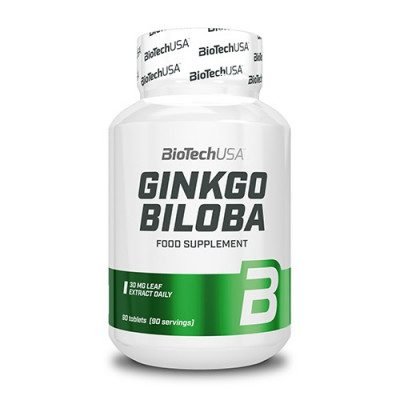 BIOTECHUSA Ginkgo Biloba€18.90 In stock 90tabs are available at maxfit.ee. Product labels specify standardised extract concentrations.
What to Combine Ginkgo With
Ginkgo's primary mechanisms include improving microcirculation and acting as an antioxidant via flavonoid components. Combinations that may complement it:
- Bacopa monnieri: Another well-studied cognitive botanical; combined nootropic formulas are common and the evidence bases are complementary rather than overlapping
- Phosphatidylserine: A membrane phospholipid with supporting cognitive evidence
- Vitamin E: Antioxidant synergy is plausible given ginkgo's flavonoid activity
Avoid combining ginkgo with blood-thinning medications or supplements (see interactions below).
Choosing a Vegan Ginkgo Product
Key checklist for vegans:
| Feature | What to look for |
|---|---|
| Capsule type | VEGE / HPMC / plant-derived or tablet form |
| Extract standardisation | Preferably labelled as EGb 761 or stating % flavonoid glycosides and terpene lactones |
| No gelatin | Check full ingredient list |
| Third-party testing | Certificate of analysis or quality certification |
Browse the full range at /en/category/ginkgo-biloba.
FAQ
Is ginkgo biloba safe for long-term use in vegans?
Ginkgo has an extensive safety record when used within recommended doses. Long-term use has been studied in the GuidAge trial (Vellas et al., 2012) and similar studies without significant safety signals at the studied dose. The main cautions concern drug interactions (particularly anticoagulants) and a risk of headache or gastrointestinal upset at higher doses.
Can vegans with low omega-3 intake combine ginkgo with a plant-based omega-3 supplement?
Yes, and this may be particularly beneficial. Omega-3 (particularly DHA) supports brain cell membrane integrity, while ginkgo supports cerebral circulation and acts as an antioxidant. These mechanisms are complementary, and combining a vegan algae-based omega-3 with ginkgo is a rational cognitive-support stack for plant-based individuals.
Does ginkgo interact with any supplements or medications?
Ginkgo has mild antiplatelet and anticoagulant properties due to its ginkgolide content. This is the most important pharmacological interaction to be aware of. Individuals taking warfarin, aspirin, other NSAIDs, or antiplatelet medications should consult a healthcare provider before adding ginkgo. Similarly, anyone scheduled for surgery should discuss with their surgeon, as increased bleeding time is a theoretical concern.
References
Vellas, B., Coley, N., Ousset, P. J., Berrut, G., Dartigues, J. F., Dubois, B., Grandjean, H., Pasquier, F., Piette, F., Robert, P., Touchon, J., Garnier, P., Mathiex-Fortunet, H., & Andrieu, S. (2012). Long-term use of standardised ginkgo biloba extract for the prevention of Alzheimer's disease (GuidAge): a randomised placebo-controlled trial. Lancet Neurology, 11(10), 851-859. https://pubmed.ncbi.nlm.nih.gov/22959217/
Hollman, P. C. H., & Arts, I. C. W. (2000). Flavonols, flavones and flavanols — nature, occurrence and dietary burden. Journal of the Science of Food and Agriculture, 80(7), 1081-1093. https://doi.org/10.1002/(sici)1097-0010(20000515)80:7<1081::aid-jsfa566>3.0.co;2-g



