Natural Food Sources of Ginkgo Biloba
Ginkgo biloba is one of the oldest surviving tree species on Earth. Its leaves and seeds have been used in traditional East Asian medicine for centuries. Today, interest in ginkgo centers on its flavonoid glycosides and terpenoids — compounds associated with circulatory and cognitive support. Before reaching for a capsule, it is worth understanding where ginkgo biloba actually appears in the food supply and what that means for anyone hoping to benefit from its compounds.
Where Ginkgo Biloba Occurs in the Diet
Unlike many botanical supplements that have close dietary cousins — such as quercetin from onions or curcumin from turmeric — ginkgo biloba's active compounds are highly specific to the Ginkgo biloba tree and are not meaningfully present in other common foods.
The primary dietary source is ginkgo seeds (baigo), which are a traditional ingredient in East Asian cuisines, particularly Chinese and Japanese cooking. They appear in congee, hot pot, soups, and certain festive dishes. The seeds contain some of the same terpenoids found in leaf extracts, though in much lower concentrations and accompanied by compounds such as ginkgotoxin (4-methoxypyridoxine), which is potentially problematic in large amounts.
Ginkgo leaves themselves are sometimes brewed as an herbal tea in parts of East Asia, but the concentration of standardized flavonoid glycosides and ginkgolides in home-brewed preparations is highly variable and generally far below the levels used in clinical research.
No other widely consumed foods — fruits, vegetables, grains, or animal products — contain meaningful amounts of the specific compounds (ginkgo flavone glycosides, bilobalide, ginkgolides A, B, C) that characterize standardized ginkgo biloba extract.
Bioavailability: Food vs Supplement
Standardized ginkgo biloba extracts used in research (typically labelled EGb 761 or equivalent) are concentrated and standardized to contain defined percentages of active constituents. The studies that form the evidence base for ginkgo biloba's effects on memory and blood flow used these standardized extracts, not dietary consumption of seeds or leaf tea.
When ginkgo seeds are cooked — which is necessary to reduce ginkgotoxin levels — some heat-sensitive terpenoids are likely degraded. The practical upshot is that you cannot replicate the effects studied in clinical trials by eating ginkgo seeds or brewing leaf tea. The food matrix, preparation method, and compound concentrations are simply too different.
Daily Targets From Diet
Because ginkgo biloba's clinically studied compounds are not present in everyday foods, there is no meaningful dietary intake target for the general population in the same way as for, say, vitamin C or potassium. Traditional East Asian diets may include ginkgo seeds a few times per week during specific seasons, but this represents culinary tradition rather than a therapeutic dose.
Eating ginkgo seeds in the quantities used as a food (a small handful in a dish) is generally considered safe, though children and those with certain health conditions should be cautious. Consuming very large amounts of seeds is associated with ginkgotoxin poisoning.
Cooking and Storage Effects
Ginkgo seeds are almost always consumed cooked rather than raw. Boiling and roasting reduce ginkgotoxin levels but also affect the terpenoid content. Standardized extract manufacturers use cold or controlled extraction and drying processes specifically to preserve the active constituent profile.
Stored ginkgo seeds should be kept cool and dry; aged or spoiled seeds can have elevated levels of undesirable compounds.
When Food Is Not Enough
For anyone interested in the well-documented effects of ginkgo biloba on cognitive function and peripheral circulation, standardized supplemental extracts are the realistic route. The evidence base for ginkgo biloba rests almost entirely on studies using standardized leaf extracts.
A meta-analysis of randomized controlled trials found that standardized ginkgo biloba extract had a modest positive effect on cognitive function in older adults with subjective memory complaints (Tan et al., 2015). A further controlled trial demonstrated improvements in cognitive symptoms in mild dementia when using a standardized EGb 761 preparation (Ihl et al., 2012).
At maxfit.ee you can find standardized ginkgo biloba supplements: MST Ginkgo Biloba 60caps and OstroVit Ginkgo Biloba Extract 50g are concentrated, standardized products designed to provide consistent levels of active compounds. 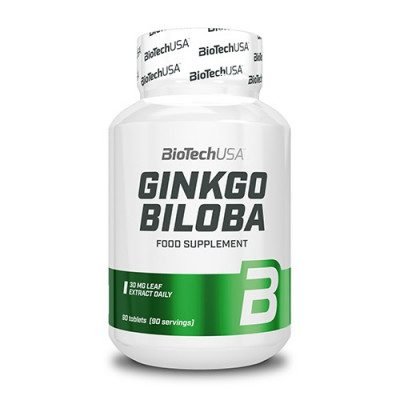 BIOTECHUSA Ginkgo Biloba€18.90 In stock 90tabs is another option for those looking for convenient daily dosing.
As with all supplements, speak with a healthcare provider before starting ginkgo biloba, especially if you take blood-thinning medications, as ginkgo has antiplatelet properties.
FAQ
Can I get enough ginkgo biloba from food alone?
For the specific compounds studied in clinical research — ginkgo flavone glycosides and terpenoids at standardized doses — food sources alone are not a practical option. Ginkgo seeds contain some related compounds but at far lower and unstandardized concentrations, and the preparation process alters their profile. Standardized supplements are the only realistic way to achieve the doses used in research.
Are ginkgo seeds safe to eat?
Cooked ginkgo seeds (baigo) consumed in moderate culinary amounts — as part of a dish — are generally safe for healthy adults. Raw or very large quantities can cause ginkgotoxin-related symptoms including nausea and, in rare cases, seizures. Children are more sensitive. Ginkgo seeds are a food, not a substitute for standardized supplements.
What is the difference between ginkgo leaf tea and a standardized extract?
Home-brewed ginkgo leaf tea contains a variable and typically very low amount of active compounds compared to a standardized extract. Standardized extracts are manufactured to precise specifications, often providing a defined amount of flavone glycosides and terpene lactones per dose — the concentrations shown in clinical studies to have measurable effects.
References
Tan, M. S., Yu, J. T., Tan, C. C., Wang, H. F., Meng, X. F., Wang, C., ... & Tan, L. (2015). Efficacy and adverse effects of ginkgo biloba for cognitive impairment and dementia: A systematic review and meta-analysis. Journal of Alzheimer's Disease, 43(2), 589-603. https://doi.org/10.3233/jad-140837
Ihl, R., Tribanek, M., & Bachinskaya, N. (2012). Efficacy and tolerability of a once daily formulation of Ginkgo biloba extract EGb 761(R) in Alzheimer's disease and vascular dementia: results from a randomised controlled trial. Pharmacopsychiatry, 45(2), 41-46. https://pubmed.ncbi.nlm.nih.gov/22086747/
van Beek, T. A., & Montoro, P. (2009). Chemical analysis and quality control of Ginkgo biloba leaves, extracts, and phytopharmaceuticals. Journal of Chromatography A, 1216(11), 2002-2032.



