
How to Maximize Ginkgo Biloba Absorption
Ginkgo biloba is one of the most studied herbal supplements for cognitive function and peripheral circulation. Its active compounds — flavone glycosides and terpenoids (ginkgolides and bilobalide) — determine its physiological effects, but getting these compounds effectively into the bloodstream requires attention to extract quality, dosing form, timing, and food pairings. Understanding ginkgo biloba absorption helps you get real value from supplementation rather than guessing at dose timing.
What Limits Ginkgo Biloba Absorption
Extract Standardisation Matters
Gastric Conditions
Ginkgo's flavonoids are absorbed in the small intestine. Taking ginkgo on a completely empty stomach may slightly accelerate initial absorption, but some individuals experience mild gastric discomfort without food. Whether faster peak concentration in plasma translates to meaningfully better outcomes has not been shown in head-to-head trials.
First-Pass Metabolism
Like many botanical compounds, ginkgo flavonoids undergo hepatic first-pass metabolism. This reduces the fraction reaching systemic circulation. The standardised EGb 761 extract is formulated to account for this — one reason why clinically used doses in trials are typically in the range used by major supplement brands.
Cofactors That May Help
Phosphatidylserine
Ginkgo is frequently co-formulated with phosphatidylserine in nootropic stacks. Both support cognitive function through different mechanisms, and phosphatidylserine's phospholipid structure may help carry lipophilic ginkgo compounds across membranes. The combination has been studied in the context of cognitive support in older adults, though the absorption synergy specifically is not fully characterised.
Healthy Fat Co-ingestion
Ginkgo terpenoids have partial lipophilicity. Consuming ginkgo with a moderate-fat meal — a handful of nuts, olive oil on food — may support absorption of the more fat-soluble fractions. This is consistent with the general principle that lipophilic plant compounds absorb better with dietary fat.
Form and Timing Effects
Capsules vs Tablets vs Liquid
Standardised EGb 761 is most commonly available in tablet or capsule form. Liquid extracts are faster to dissolve but are often lower in standardised terpenoid content. For most users, a quality capsule or tablet with a meal is the most practical approach.
Twice-Daily Dosing
Consistency Over Weeks
Ginkgo's effects on cerebral blood flow and cognitive function are not acute in the sense that a single dose produces dramatic effects. Studies assessing cognitive benefits typically run for four to twelve weeks. Consistent daily use is more important than optimising any individual dose timing.
Food Pairings
Consuming ginkgo with a mixed meal that includes some fat is a reasonable strategy. Foods that are particularly helpful are those containing healthy fats — nuts, seeds, avocado, olive oil — which may support absorption of lipophilic terpenoids. There is no evidence that any specific food dramatically increases or blocks ginkgo bioavailability at amounts typical in normal meals.
Avoid combining ginkgo with very large doses of supplements that thin the blood — such as high-dose fish oil or vitamin E — because ginkgo itself has mild antiplatelet effects (Bal Dit Sollier et al., 2003). The concern is not absorption but additive effects on coagulation.
Practical Tips for Best Absorption
- Choose a standardised EGb 761 extract — look for products specifying 24% flavonoids and 6% terpenoids.
- Take with a meal containing some fat to support terpenoid absorption.
- Split the daily dose across morning and afternoon rather than taking all at once.
- Use consistently for at least four weeks before evaluating subjective effects.
- Avoid combining with anticoagulants or high-dose blood thinners without medical clearance — the issue is pharmacodynamic, not absorption.
Products such as MST Ginkgo Biloba 60caps, OstroVit Ginkgo Biloba Extract 50g, and 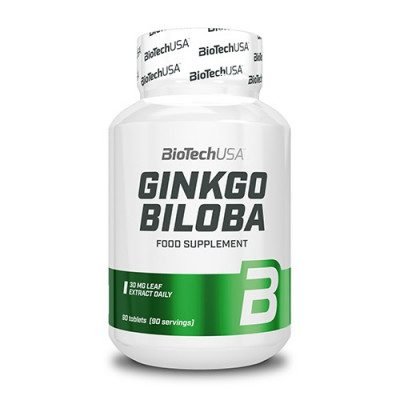 BIOTECHUSA Ginkgo Biloba€18.90 In stock 90tabs are available at maxfit.ee. For broader cognitive support, explore our energy and brain category.
FAQ
Does ginkgo work better on an empty stomach?
Not necessarily. While absorption speed may be slightly faster on an empty stomach, taking ginkgo with a small meal containing fat may support absorption of its lipophilic terpenoids. Many people also tolerate it better with food. Overall absorption is not dramatically different.
How long does ginkgo biloba take to work?
Studies on cognitive and circulatory effects typically use supplementation periods of four to twelve weeks. Expecting noticeable effects after a single dose or the first week is unrealistic. Consistent use over a month or more is the evidence-supported timeframe.
Can I take ginkgo with my blood pressure medication?
Ginkgo has mild blood-pressure effects and may interact with antihypertensives. More critically, it has antiplatelet properties that may interact with anticoagulants such as warfarin. Always disclose ginkgo use to your doctor and pharmacist if you are on any cardiovascular medications.
References
Bal Dit Sollier, C., Caplain, H., & Drouet, L. (2003). No alteration in platelet function or coagulation induced by EGb761 in a controlled study. Clinical Laboratory Haematology, 25(4), 251-253. https://doi.org/10.1046/j.1365-2257.2003.00527.x



