Energy Complexes: Latest Research and Evidence Update
Energy complexes — multi-ingredient supplements combining compounds like caffeine, B vitamins, adaptogens, amino acids, and plant extracts to support mental and physical energy — represent one of the most active areas of supplement research. The category has expanded significantly, and the research landscape has shifted as newer trials have clarified some claims and undermined others. Here is an evidence-focused update on what the science currently says.
What Recent Trials Show
Caffeine remains the bedrock. The most consistent finding across energy complex trials is that caffeine is responsible for the majority of measurable performance effects. Studies separating caffeine from the rest of the formula consistently show that the ergogenic contribution of non-caffeine components is smaller and less consistent (Heckman et al., 2010). This does not mean other ingredients are useless, but it contextualises their role.
B vitamins: necessary but not energizing in isolation. B vitamins (especially B1, B2, B3, B5, B6, B12) are essential coenzymes in energy metabolism pathways. Supplementation corrects deficiency-related fatigue, but in individuals already meeting requirements from diet, additional B vitamins do not produce measurable energy increases. Marketing that positions B vitamins as "energy boosters" overstates the evidence in replete populations.
Adaptogens are getting more rigorous study. Ashwagandha (Withania somnifera) has accumulated RCT evidence for reducing perceived fatigue and supporting stress resilience. One systematic review of RCTs found meaningful improvements in self-reported vitality and fatigue scores compared to placebo (Pratte et al., 2014). Rhodiola rosea similarly has multiple small RCTs suggesting reduced mental fatigue. These effects are real but modest — they are stress-buffer effects, not stimulant-equivalent energy increases.
CoQ10 (coenzyme Q10) for mitochondrial energy: CoQ10 is involved in the electron transport chain and ATP production. Evidence for CoQ10 supplementation improving exercise performance in healthy, well-nourished individuals is mixed. Benefit is more consistently seen in older adults or those with mitochondrial dysfunction. ICONFIT Capsules Coenzyme Q10 90caps is one of the products in this space available at maxfit.ee.
Taurine's role is clarifying. Taurine, long included in energy drinks, is an osmoregulatory amino acid with antioxidant properties. Recent research suggests it may reduce exercise-induced oxidative stress but has minimal direct stimulant effect. Its presence in energy complexes likely contributes to endurance and recovery support rather than acute energy sensation.
Shifts in Consensus
The most significant consensus shift in the past few years involves single-ingredient vs. multi-ingredient comparisons. Earlier marketing positioned energy complexes as synergistic — the sum being greater than its parts. More recent well-controlled crossover designs have found that for most measurable outcomes (reaction time, endurance capacity, perceived energy), caffeine alone accounts for most of the effect, and adding 5–15 other ingredients typically adds marginal, inconsistent benefit.
This has prompted some researchers and informed formulators to advocate for cleaner, fewer-ingredient "transparent formula" products where doses are specified and attributable. OstroVit Guarana Extract 100g is an example of a single-source caffeine-bearing product where the active component is unambiguous.
A second shift involves dose timing and form: liquid and dissolvable formats (shots, effervescent tablets) produce faster onset than capsules due to absorption kinetics, which is relevant for users who time their energy complex use to a specific pre-activity window.
Still-Open Questions
Several questions remain unresolved:
-
Habituation rate for multi-ingredient formulas: It is well-established that caffeine tolerance develops with regular use. Whether the non-caffeine components of energy complexes (adaptogens, amino acids) habituate similarly, antagonistically, or independently is not well studied.
-
Interaction effects between adaptogens and stimulants: Ashwagandha's cortisol-modulating effects and caffeine's cortisol-elevating effects theoretically interact. Whether co-administration blunts, augments, or has no effect on the net stress response requires more dedicated crossover research.
-
Long-term safety of novel plant extracts: Many newer energy complexes include extracts with limited long-term human safety data. Proprietary blends of lesser-studied botanicals represent a gap in the evidence base.
What It Means Practically
- If caffeine is effective for you, a straightforward caffeine + B vitamin product is likely to deliver most of what a complex energy blend offers, at lower cost.
- Adaptogens (ashwagandha, rhodiola) add stress-resilience value that is distinct from stimulant energy — they are worth considering separately or as part of a formula if chronic fatigue, not acute energy deficit, is your concern.
- Check that the formula lists individual ingredient doses. If it uses a proprietary blend, you cannot verify you are receiving therapeutic amounts of anything.
- OstroVit Braintus Focus 90caps, OstroVit Braintus Thunder 90caps, and
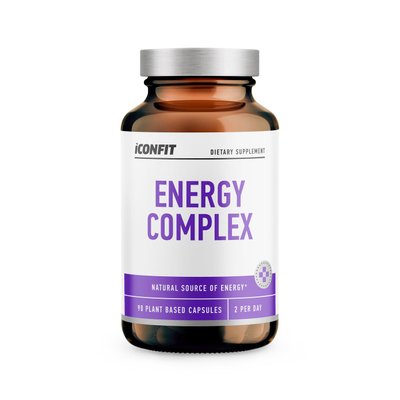 ICONFIT Capsules Energy Complex N90€12.90 In stock are transparent-format options available at maxfit.ee.
Bottom Line
Energy complex research is maturing. The category delivers real effects, but caffeine remains the dominant driver. Adaptogens add meaningful stress-resilience value in their own right. The field is moving toward transparency and away from kitchen-sink formulas. Consumers who understand the ingredient breakdown are better equipped to choose products that match their actual needs.
References
- Heckman, M. A., Weil, J., & Gonzalez de Mejia, E. (2010). Caffeine (1, 3, 7-trimethylxanthine) in foods: a comprehensive review on consumption, functionality, safety, and regulatory matters. Journal of Food Science, 75(3), R77-R87. https://pubmed.ncbi.nlm.nih.gov/20492310/
- Pratte, M. A., Nanavati, K. B., Young, V., & Morley, C. P. (2014). An alternative treatment for anxiety: a systematic review of human trial results reported for the Ayurvedic herb ashwagandha (Withania somnifera). Journal of Alternative and Complementary Medicine, 20(12), 901-908. https://pubmed.ncbi.nlm.nih.gov/25405876/
- Glade, M. J. (2010). Caffeine-Not just a stimulant. Nutrition, 26(10), 932-938. https://pubmed.ncbi.nlm.nih.gov/20888549/
FAQ
Are energy complexes safe to take daily?
For most healthy adults, energy complexes used at recommended doses and within standard caffeine intake limits are generally safe. The primary concern with daily use is caffeine habituation and sleep disruption if taken too late in the day. Cycling use (e.g., weekdays only) can help maintain sensitivity.
Do energy complexes actually improve cognitive performance?
Caffeine reliably improves alertness, reaction time, and short-term working memory at therapeutic doses. Adaptogens may reduce perceived mental fatigue. The combined effect in a well-formulated energy complex can be meaningful for cognitive performance, particularly under sleep-restricted or high-stress conditions.
What is the difference between an energy complex and a pre-workout?
Pre-workouts typically include ergogenic compounds targeting exercise performance specifically (creatine, citrulline, beta-alanine). Energy complexes focus more broadly on mental energy, alertness, and stress resilience, often with adaptogens. There is significant overlap at the product level.



