
EAA Myths vs Facts
Essential amino acids — the nine amino acids the human body cannot synthesise and must obtain from diet — have become a popular supplement category. EAA products are marketed aggressively to athletes seeking muscle protein synthesis support, recovery optimisation, and a lower-calorie alternative to whole protein powders. Some of the surrounding claims are well-grounded; others are overstated. Here is what the science actually says.
Common Myths
Myth 1: EAAs are superior to complete protein sources for muscle building
EAAs do stimulate muscle protein synthesis. But this does not mean they are superior to high-quality complete protein sources like whey. Whole protein sources also provide EAAs, alongside non-essential amino acids that contribute to cellular functions. A meta-analysis of protein supplementation showed that whey protein — a complete protein delivering all essential amino acids — reliably increases lean mass when combined with resistance training (Morton et al., 2018). EAAs used in isolation replicate the essential fraction without the caloric and non-essential amino acid cost, which has use cases but is not categorically better.
Myth 2: You need EAAs during training to avoid muscle breakdown
For people consuming adequate total daily protein from meals, the evidence that intra-workout EAA supplementation provides meaningful additional benefit is limited. Muscle protein breakdown does increase during resistance exercise, but net protein balance is determined by the totality of daily protein intake, not whether amino acids were consumed at the exact moment of training.
Myth 3: EAA supplements are just expensive BCAAs
This is a meaningful distinction. BCAAs (leucine, isoleucine, valine) are three of the nine EAAs. Leucine is the primary trigger of mTOR-mediated muscle protein synthesis signalling. However, the full EAA pool is needed for complete protein synthesis — the ribosome cannot build a complete protein chain if any essential amino acid is absent. EAA supplements that provide all nine essential amino acids are mechanistically more complete than leucine-dominant BCAA products for supporting the full synthesis process.
Myth 4: EAAs are only for athletes
Older adults experience age-related muscle loss (sarcopenia), and their anabolic response to protein is blunted compared to younger adults — they need more leucine per stimulus to achieve the same synthetic response. EAA supplements with higher leucine content have been studied in older adults as a strategy to counteract sarcopenia (Paddon-Jones & Rasmussen, 2009). This is not an athlete-only application.
What the Evidence Actually Shows
The evidence supports EAA supplementation as most beneficial when:
- Total daily protein intake from whole foods falls short of recommended targets for athletes
- The supplement is used during fasting states (e.g., fasted morning training) when amino acid availability is genuinely low
- The goal is to stimulate muscle protein synthesis with minimal caloric load (useful for body recomposition or calorie restriction contexts)
- For individuals who struggle to consume adequate protein from whole food sources
OstroVit EAA 200g Lõuna-Ameerika puuviljad ja greip and MST BCAA EAA 40serv Must sõstar are among the EAA formulas available in the EAA category at maxfit.ee. 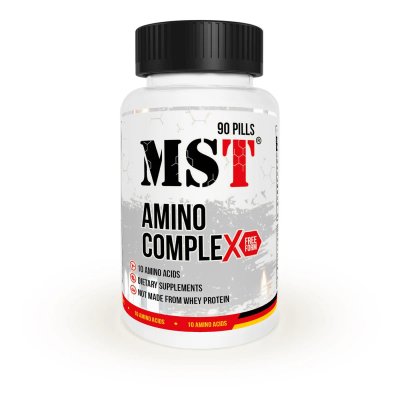 MST Amino Complex 90 pills€16.90 In stock provides EAAs in capsule form for those who prefer not to mix powders.
Marketing Claims vs Reality
- "Prevents muscle catabolism during training": at adequate daily protein intake, intra-workout catabolism is a minor concern. This claim is more relevant to fasted training or very prolonged sessions.
- "Faster absorption than whole protein": free-form amino acids do absorb rapidly, but the practical significance of absorption speed for post-exercise muscle protein synthesis is minimal when protein is consumed within a few hours of training (Trommelen & van Loon, 2016).
- "Zero calories, maximum muscle": EAAs do contain calories (amino acids yield approximately 4 kcal/g), but the caloric load of a typical EAA serving is substantially lower than a whole protein powder serving — this is a real practical advantage for caloric restriction contexts.
Grey Areas
- Optimal EAA dose: the dose needed to maximally stimulate muscle protein synthesis is well-established for leucine but less clear for the complete EAA mixture. Context (age, training status, concurrent protein intake) affects the effective dose.
- EAAs vs protein powder: for most people eating adequate total daily protein, the choice between an EAA supplement and a complete protein powder is largely a matter of practical preference (taste, caloric load, cost) rather than a meaningful physiological difference.
- Timing windows: the "anabolic window" immediately post-exercise is real but wider than once thought — a few hours on either side of training is sufficient for most individuals consuming adequate total daily protein.
Bottom Line
EAAs are a legitimate tool for supporting muscle protein synthesis, particularly useful in fasted states, during caloric restriction, or for older adults with blunted anabolic responses. They are not categorically superior to quality whole protein sources. The choice between EAAs and whey protein should be guided by context, practical preference, and total daily protein targets rather than marketing claims.
Explore the EAA category at maxfit.ee to find a format that suits your training routine.
FAQ
How many grams of EAAs should I take per serving?
Most EAA products provide between 5 g and 15 g per serving, with the effective range for stimulating muscle protein synthesis in younger adults starting from around 3 g of leucine within the mixture. Older adults may need higher total EAA doses to achieve the same anabolic response. Following the product dosing instructions as a starting point is reasonable.
Can I take EAAs instead of protein powder?
You can, but it is not always the most cost-efficient choice. EAA supplements provide only the essential amino acid fraction without the additional macronutrients and calories of a full protein powder. If your total daily protein from food is adequate, EAAs as a training supplement and protein powder as a meal supplement can serve complementary roles.
Are EAAs safe for daily use?
EAAs are dietary protein components taken in supplemental form — they do not have the toxicity profile of pharmacological substances. Daily use at typical supplement doses is safe for healthy individuals with normal kidney function. As with all protein sources, individuals with specific health conditions should consult a health professional.
References
Morton, R. W., Murphy, K. T., McKellar, S. R., Schoenfeld, B. J., Henselmans, M., Helms, E., Aragon, A. A., Devries, M. C., Banfield, L., Krieger, J. W., & Phillips, S. M. (2018). A systematic review, meta-analysis and meta-regression of the effect of protein supplementation on resistance training-induced gains in muscle mass and strength in healthy adults. British Journal of Sports Medicine, 52(6), 376-384. https://pubmed.ncbi.nlm.nih.gov/28698222/
Paddon-Jones, D., & Rasmussen, B. B. (2009). Dietary protein recommendations and the prevention of sarcopenia. Current Opinion in Clinical Nutrition and Metabolic Care, 12(1), 86-90. https://pubmed.ncbi.nlm.nih.gov/19057193/
Trommelen, J., & van Loon, L. J. C. (2016). Pre-sleep protein ingestion to improve the skeletal muscle adaptive response to exercise training. Nutrients, 8(12), 763. https://pubmed.ncbi.nlm.nih.gov/27916799/



