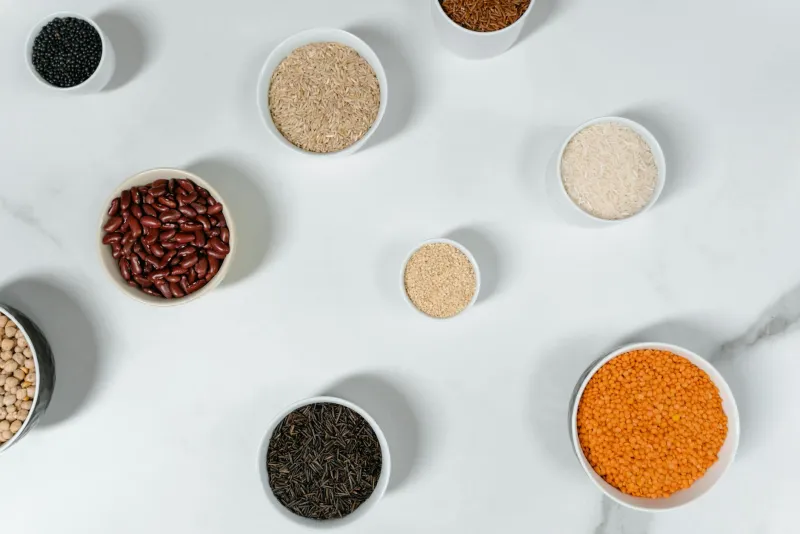
Natural Food Sources of EAA
Essential amino acids — commonly abbreviated EAA — are the nine amino acids the human body cannot synthesise on its own: histidine, isoleucine, leucine, lysine, methionine, phenylalanine, threonine, tryptophan, and valine. Every cell relies on a continuous supply from food. Understanding the best EAA food sources is the starting point for anyone serious about muscle health, recovery, or overall protein quality.
Top Food Sources of All Nine EAA
Complete proteins contain all nine EAA in proportions close to human requirements. Animal-sourced foods are the most concentrated and complete:
| Food (100 g cooked) | Complete EAA profile | Approx. protein |
|---|---|---|
| Chicken breast | Yes | ~31 g |
| Beef (lean) | Yes | ~27 g |
| Salmon | Yes | ~25 g |
| Eggs (2 large) | Yes | ~12 g |
| Greek yoghurt | Yes | ~10 g |
| Tempeh | Yes | ~19 g |
| Quinoa | Yes | ~4 g |
| Soybeans (cooked) | Yes | ~17 g |
Among plant proteins, soy and quinoa stand out as complete proteins. Most other legumes and grains are limiting in one or more EAA — typically lysine (grains) or methionine and cysteine (legumes) — but combining different plant foods across the day provides the full EAA spectrum.
Eggs are frequently cited as the reference protein because their amino acid profile closely mirrors human needs. Leucine, the EAA most closely linked to signalling muscle protein synthesis, is particularly well-represented in whey, meat, and eggs.
Bioavailability from Food vs Supplement
Bioavailability describes how efficiently amino acids are digested, absorbed, and ultimately used. Animal proteins score highly on digestibility — digestibility-corrected amino acid scores (DIAAS) of 1.0 or above are common for egg, milk, and meat proteins (Wolfe et al., 2016). Most intact plant proteins score somewhat lower, with digestibility in the range of 0.6–0.9 depending on the food and preparation.
Free-form EAA supplements, by definition, bypass digestion entirely: they are absorbed directly across the intestinal wall. This means peak plasma amino acid levels are reached faster than from whole food. For practical purposes — regular meals eaten at normal intervals — this speed advantage rarely matters. It becomes relevant for intra-workout supplementation or when appetite is suppressed around training.
Daily Targets from Diet
For most active adults, aiming for 1.6–2.2 g of total protein per kilogram of body weight per day, distributed across three to four meals, ensures adequate EAA intake from a mixed diet. The International Society of Sports Nutrition supports this range for muscle maintenance and growth, noting that distributing protein across meals optimises muscle protein synthesis signalling (Morton et al., 2018).
Vegans achieving this protein range from diverse whole plant foods (legumes, soy, whole grains, nuts, seeds) can meet EAA needs, though careful planning is required, particularly for lysine.
Cooking and Storage Effects on EAA
Protein itself is stable to standard cooking methods; EAA are not destroyed by heat. The Maillard reaction — browning that occurs at high temperatures — can slightly reduce lysine availability by binding it to sugars, but this is rarely nutritionally significant in practice. Harsh industrial processing (e.g., extrusion at very high temperatures) may reduce digestibility more meaningfully.
Storage of dried legumes and grains at normal conditions for reasonable periods causes no significant EAA loss.
When Food Is Not Enough
Several situations make targeted EAA supplementation practical:
- Peri-workout nutrition: consuming EAA around training can support muscle protein synthesis when whole-food meals are not feasible.
- Appetite limitations: athletes in weight-class sports or those managing caloric restriction may struggle to hit protein targets from food volume alone.
- Plant-dominant diets: a free-form EAA supplement addresses gaps in plant protein profiles more precisely than calculating food combinations.
- Older adults: muscle protein synthesis sensitivity to leucine declines with age; a leucine-rich EAA supplement can help achieve the threshold stimulus when meals are smaller.
At maxfit.ee, you can find convenient EAA options including OstroVit EAA 200g Lõuna-Ameerika puuviljad ja greip and MST BCAA EAA 40serv Must sõstar — both providing the full essential amino acid spectrum in readily absorbable form. Optimum-nutrition Amino Energy 30 servings Apelsin combines EAA with light stimulants for a practical peri-workout option.
Browse the full EAA range at maxfit.ee.
FAQ
Can I get all EAA from a vegan diet?
Yes, but it requires planning. Soy and quinoa are complete plant proteins. Combining legumes with grains across the day — for example, rice and lentils, or bread and hummus — covers the full EAA spectrum. Meeting total protein targets is the most practical approach rather than tracking individual amino acids.
Do EAA supplements help muscle growth compared to food protein?
When total protein intake is adequate, free-form EAA supplements do not offer a clear advantage over food-sourced protein for muscle growth (Wolfe et al., 2016). Their practical advantage is speed and convenience around training, particularly when appetite or food access is limited.
Is leucine the most important EAA for athletes?
Leucine plays a unique role as a trigger for muscle protein synthesis signalling. Research suggests that a threshold amount of leucine in a meal is required to maximally activate this response (Morton et al., 2018). This is why high-leucine proteins — whey, eggs, meat — are frequently recommended for post-workout consumption.
References
Wolfe, R. R., Cifelli, A. M., Kostas, G., & Kim, I. Y. (2017). Optimizing Protein Intake in Adults: Interpretation and Application of the Recommended Dietary Allowance Compared with the Acceptable Macronutrient Distribution Range. Advances in Nutrition, 8(2), 266-275. https://pubmed.ncbi.nlm.nih.gov/28298271/
Morton, R. W., Murphy, K. T., McKellar, S. R., Schoenfeld, B. J., Henselmans, M., Helms, E., ... & Phillips, S. M. (2018). A systematic review, meta-analysis and meta-regression of the effect of protein supplementation on resistance training-induced gains in muscle mass and strength in healthy adults. British Journal of Sports Medicine, 52(6), 376-384. https://pubmed.ncbi.nlm.nih.gov/28698222/
Fabian, E., Majchrzak, D., Dieminger, B., Meyer, E., & Elmadfa, I. (2008). Influence of probiotic and conventional yoghurt on the status of vitamins B1, B2 and B6 in young healthy women. Annals of Nutrition and Metabolism, 52(1), 29-36. https://pubmed.ncbi.nlm.nih.gov/18230968/



