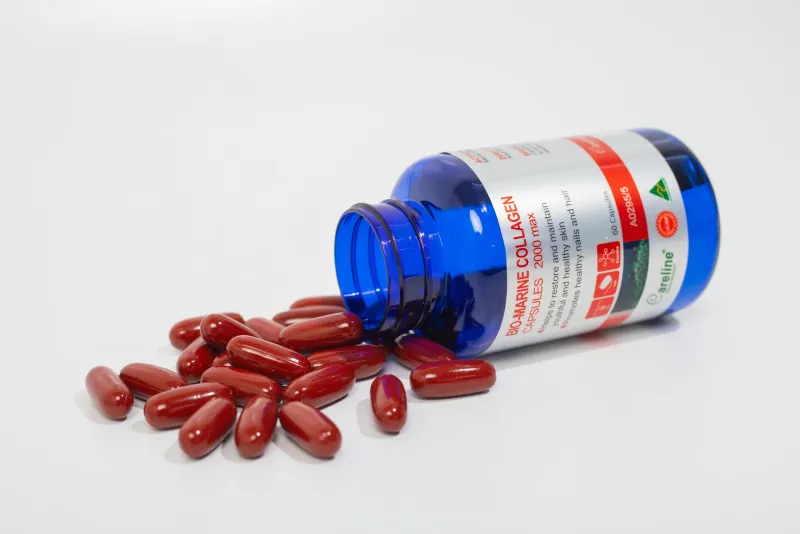
What Is Collagen and Why Does Dosage Matter?
Collagen is the most abundant structural protein in the human body, forming the scaffold of skin, cartilage, tendons, ligaments, and bone. Dietary collagen supplements are typically sold as hydrolysed collagen peptides — short chains of amino acids derived from bovine, marine, or porcine collagen — which are absorbed more efficiently than intact collagen.
The dose matters because the concentration of specific peptides in the bloodstream after absorption appears to influence fibroblast and chondrocyte activity. Bioavailable peptides — particularly prolyl-hydroxyproline and hydroxyproline — have been shown to stimulate collagen synthesis in vitro and in animal models, forming the mechanistic basis for human dosing trials.
Studied Effective Dose Ranges
A systematic review and meta-analysis of 19 RCTs found that oral collagen supplementation at doses predominantly of 2.5–10 g per day significantly improved skin hydration, elasticity, and wrinkle parameters versus placebo, with study durations of four to twenty-four weeks (de Miranda et al., 2021).
For joint health, a placebo-controlled RCT by Clark et al. (2008) found that athletes taking 10 g of collagen hydrolysate per day for twenty-four weeks reported significantly less joint pain during activity compared with placebo. This study used a product standardised to specific peptide fractions and measured outcomes using a validated activity pain scale.
For bone support, a two-year RCT in postmenopausal women found that 5 g of specific collagen peptides per day, combined with calcium and vitamin D, produced greater improvements in bone mineral density than calcium and vitamin D alone (König et al., 2018).
Dose by Goal
- Skin elasticity and hydration: 2.5–10 g hydrolysed collagen per day, with evidence across the range but particularly for 2.5 g specific bioactive peptides.
- Joint pain support: 10 g per day, as used in the Clark et al. (2008) RCT protocol.
- Bone mineral density support: 5 g per day specific collagen peptides alongside adequate calcium and vitamin D.
Upper Limits and Safety
Collagen peptides are derived from food proteins and have a favourable safety profile. No tolerable upper intake level has been established by EFSA, and studies using doses up to 15 g per day report no serious adverse effects. The primary practical caution is allergenicity: marine collagen may cause reactions in people with fish allergies; bovine collagen in people with beef sensitivities.
Collagen peptides are not a complete protein source — they are low in tryptophan. They should complement, not replace, overall protein intake from diverse sources.
Timing Relative to Dose
A study by Shaw et al. (2017) found that consuming 15 g of gelatin (a form of collagen) with 50 mg of vitamin C, approximately one hour before exercise, significantly increased collagen synthesis markers compared with placebo. This suggests a pre-exercise timing window for athletes targeting joint or connective tissue outcomes. For skin outcomes, timing relative to exercise is less relevant; consistency over several months matters more.
Practical Protocol
- Skin goal: 2.5–5 g hydrolysed collagen per day, ideally with a small dose of vitamin C (50–100 mg) to support endogenous synthesis. Take consistently — visible improvements typically require eight to twelve weeks.
- Joint support goal: 10 g per day, taken thirty to sixty minutes before exercise when possible.
- Bone support goal: 5 g per day specific collagen peptides alongside your standard calcium and vitamin D regimen.
Browse collagen supplements at maxfit.ee for available options in Estonia.
References
de Miranda, R. B., Weimer, P., & Rossi, R. C. (2021). Effects of hydrolyzed collagen supplementation on skin aging: a systematic review and meta-analysis. International Journal of Dermatology, 60(12), 1449–1461. PMID: 33742704
Clark, K. L., Sebastianelli, W., Flechsenhar, K. R., Aukermann, D. F., Meza, F., Millard, R. L., Deitch, J. R., Sherbondy, P. S., & Albert, A. (2008). 24-Week study on the use of collagen hydrolysate as a dietary supplement in athletes with activity-related joint pain. Current Medical Research and Opinion, 24(5), 1485–1496. PMID: 18416885 https://pubmed.ncbi.nlm.nih.gov/18416885/
König, D., Oesser, S., Scharla, S., Zdzieblik, D., & Gollhofer, A. (2018). Specific collagen peptides improve bone mineral density and bone markers in postmenopausal women — a randomized controlled study. Nutrients, 10(1), 97. PMID: 29337906
Shaw, G., Lee-Barthel, A., Ross, M. L., Wang, B., & Baar, K. (2017). Vitamin C–enriched gelatin supplementation before intermittent activity augments collagen synthesis. American Journal of Clinical Nutrition, 105(1), 136–143. PMID: 27852613 https://pubmed.ncbi.nlm.nih.gov/27852613/
FAQ
What is the minimum effective dose of collagen for skin?
The lowest dose consistently shown to produce statistically significant skin improvements in RCTs is 2.5 g per day of specific bioactive collagen peptides over eight to twelve weeks. Generic hydrolysed collagen at this dose also shows benefit, though the evidence for specific peptide-standardised products is stronger.
Does the source of collagen (bovine vs marine) matter?
Both bovine and marine collagen have supporting RCT evidence. Marine collagen is absorbed slightly more efficiently due to smaller peptide size, but comparative head-to-head RCTs showing clinically meaningful superiority of one over the other in humans are limited. Choose based on dietary preferences and allergy profile.
How long should I take collagen to see results?
For skin outcomes, most RCTs run for eight to twenty-four weeks before measuring significant outcomes. For joint pain, the Clark et al. (2008) RCT ran for twenty-four weeks. Expect a minimum commitment of two to three months to assess results.



