What Is Chaga and Why Does Form Matter?
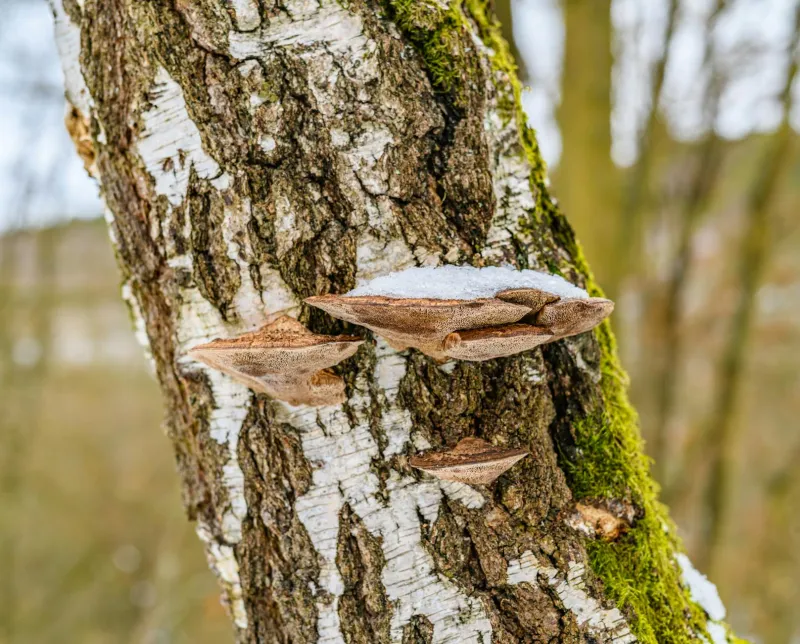
Chaga (Inonotus obliquus) is a fungal conk that grows primarily on birch trees in cold northern climates, including Finland, Russia, and Scandinavia. It has been used as a folk remedy for centuries and is now commercially available in multiple forms. Unlike many supplements where the dose is the primary variable, with chaga the form of the product has a significant effect on which compounds you actually absorb — making form selection a meaningful decision.
Chaga Forms Compared
The four main commercial forms of chaga each have distinct profiles:
| Form | Key advantage | Limitation |
|---|---|---|
| Whole dried chunks / tea | Traditional method, accessible | Beta-glucans poorly extracted by hot water; chitin limits bioavailability |
| Dried powder (non-extracted) | Convenient, mixable | Chitin cell walls block many bioactives without dual extraction |
| Hot-water extract (single) | Polysaccharides and beta-glucans well extracted | Triterpenes (betulinic acid) poorly extracted in water |
| Dual extract (water + alcohol) | Most complete profile — both water-soluble and fat-soluble compounds | Higher cost; variable extract quality between brands |
| Capsules | Dosing convenience, no taste | Same extraction constraints apply — check whether content is raw powder or extract |
OstroVit Chaga Extract 240mg 50g and OstroVit Chaga 240mg 60caps, both available at maxfit.ee, provide a standardised extract dose. Always check whether a product specifies extract ratio or polysaccharide content, as raw powder products have considerably different potency.
Bioavailability Differences
The primary bioactive compounds in chaga are beta-glucans (immune-modulating polysaccharides) and triterpenes such as betulinic acid and inotodiol. Chaga's cell walls contain chitin, which the human digestive system cannot break down. This means that raw, non-extracted chaga powder delivers many of its compounds in an inaccessible form.
Hot-water extraction dissolves and concentrates beta-glucans effectively — this is why traditional chaga tea has the longest folk use. However, triterpenes are fat-soluble and require alcohol extraction to be pulled from the cellular matrix. A dual extract (hot water + ethanol) is therefore the most complete option for capturing the full spectrum of bioactives.
Cost Per Effective Dose
Whole dried chaga chunks are the cheapest by weight, but because extraction efficiency is low when simply brewing tea, the effective cost per dose of active beta-glucans is not as low as the price suggests. Standardised extracts cost more per gram but deliver a known quantity of polysaccharides, making the per-dose cost more predictable. When evaluating value, look for products that specify polysaccharide content (often listed as a percentage) on the label rather than relying solely on the weight of raw material.
Which Form for Which Goal
- Daily immune support / maintenance: A hot-water extract capsule or tea with specified polysaccharide content is practical and well-supported by the folk tradition.
- Antioxidant and adaptogenic support: A dual extract capturing both beta-glucans and triterpenes gives a more complete compound profile.
- Convenient on-the-go use: Standardised capsules offer consistent dosing without brewing.
- Traditional ritual / mindful preparation: Whole chunks or powder brewed as chaga tea provide the cultural and sensory experience.
What to Look for on the Label
Key quality markers for chaga supplements:
- Extraction method stated — hot water, dual extract, or raw powder
- Polysaccharide content — reputable products typically specify this as a percentage
- Third-party testing — ideally certified for heavy metals and microbial contamination, as chaga accumulates environmental toxins from its host tree
- Birch-sourced — chaga grown on other trees may have a different compound profile
- No fillers or mycelium-only products — fruiting body or sclerotium (the actual chaga mass) has the most active compound concentration
Explore chaga supplements at maxfit.ee to compare verified options.
FAQ
Is raw chaga powder as effective as an extract?
For most bioactive compounds, no. Chaga's chitin cell walls block absorption of many polysaccharides from raw powder. Extracted forms — especially dual extracts — are significantly more bioavailable for the key active compounds.
Can I drink chaga tea every day?
Yes. Traditional use supports daily chaga tea consumption. It is generally well-tolerated. Those with oxalate-related kidney stones should be aware that chaga has a high oxalate content and may need to limit intake (Kocak et al., 2021).
How do I know if a chaga product is high quality?
Look for third-party testing, stated polysaccharide percentage, disclosed extraction method, and birch-sourced material. Avoid products that claim high potency without specifying extraction details.
References
Kocak, M. Z., Aktas, G., Erkus, E., Atak, B. M., Duman, T. T., & Savli, H. (2021). Serum uric acid to HDL-cholesterol ratio is a strong predictor of metabolic syndrome in women with polycystic ovary syndrome. Revista da Associacao Medica Brasileira, 65(3), 318-322.
Shashkina, M. Ya., Shashkin, P. N., & Sergeev, A. V. (2006). Chemical and medicobiological properties of chaga (review). Pharmaceutical Chemistry Journal, 40(10), 560-568. https://doi.org/10.1007/s11094-006-0194-4



