


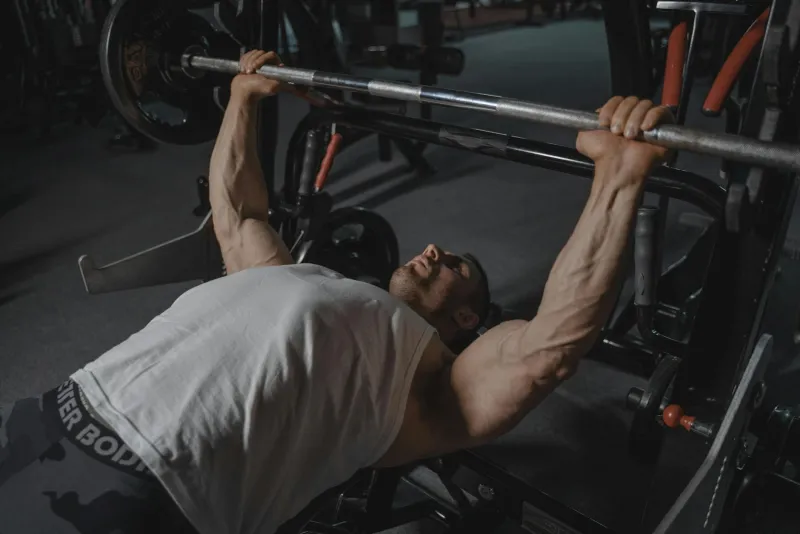
Bench Press Mistakes: 10 Most Common Errors and How to Avoid Them
The bench press is one of the most popular exercises in the gym. Unfortunately, it's also one of the exercises most commonly performed incorrectly. Bad habits can lead to injuries and limit your progress (Haupt, 2001). Let's look at 10 common mistakes and how to fix them.
Mistake #1: Wrong Foot Position
The Problem
Many lifters either leave their feet in the air, cross them on the bench, or place them too far away.
Why It Matters
- Feet are the foundation for force transfer
- "Leg drive" helps lift more weight
- Stability starts from the ground
The Solution
Correct foot position:
- Feet firmly on the ground
- Knees at 90° angle or slightly less
- Heels on ground (except in special cases)
- Knees pushed slightly out
Using leg drive:
- Push feet into ground, don't just rest them
- Force travels from legs through hips to chest
- Practice leg drive separately with light weight
Mistake #2: Bouncing the Bar Off Chest
The Problem
Bouncing the bar off the chest uses momentum, not muscle power, and can cause chest injuries.
Why It's Dangerous
- Risk of rib and sternum injuries
- Reduces actual muscle load
- Pause is mandatory in competition
The Solution
Controlled descent:
- Lower for 2-3 seconds with control
- Touch chest lightly (don't slam!)
- Make a brief pause at bottom
- Press up without bouncing
Practice pause presses:
- 1-2 seconds on chest
- Develops strength from bottom
- Improves technique
Mistake #3: Wrong Grip Width
The Problem
Grip too narrow or too wide reduces power and increases injury risk.
Finding the Right Grip
Too narrow:
- Excessive triceps load
- Less chest activation
- Longer range of motion
Too wide:
- Shoulder injury risk
- Less triceps work
- Unstable position
The Solution
Optimal grip:
- Hands 1.5x shoulder width
- Elbows at 45-75° angle at bottom
- Forearm vertical at bottom
How to find it:
- Lie down without bar
- Press hands up "naturally"
- Mark that width
- Test with bar
Mistake #4: Elbows Flared Too Wide
The Problem
Elbows fully flared (90° from body) puts tremendous pressure on the shoulder joint.
Why It's Dangerous
- Shoulder ligament overload
- Rotator cuff injuries
- Impingement syndrome
The Solution
Correct elbow position:
- 45-75° angle with body
- Not T-shape (90°)
- Not too tucked (under 45°)
Visual cue:
- "Arrow, not T" - body is like an arrow, not T-letter
- Elbows pointing toward feet
Mistake #5: Wrong Bar Path
The Problem
Straight up-and-down movement isn't biomechanically optimal.
Why It Matters
- Straight path is inefficient
- Increases shoulder load
- Reduces power production
The Solution
Correct trajectory (J-curve):
- Start position: Bar over shoulders (not over face)
- Descent: Diagonally down toward lower chest
- Bottom: Nipple line or slightly below
- Ascent: Diagonally back over shoulders
Visual: Viewed from side, forms J-shape.
Mistake #6: No Back Arch
The Problem
Lying completely flat on bench removes the advantages of a powerful position.
Why Arch Matters
- Creates stable base
- Shortens range of motion
- Protects shoulders
- Increases chest activation
The Solution
Correct back arch:
- Pull shoulder blades together and down
- Create slight lower back arch (fist should fit under)
- Glutes stay on bench
- Maintain throughout lift
Note: The arch isn't "cheating" - it's part of technique!
Mistake #7: Wrong Breathing
The Problem
Breathing during descent or lifting without holding breath.
Why Breathing Matters
- Intra-abdominal pressure stabilizes spine
- Valsalva maneuver increases power
- Controlled breathing = controlled lift
The Solution
Correct breathing technique:
- Before descent: Deep breath, hold
- Descent: Hold breath
- Bottom: Still holding
- Ascent: Exhale at sticking point or top
On heavy lifts:
- Valsalva maneuver (strong intra-abdominal pressure)
- Breathe between sets, not reps
Mistake #8: Descending Too Fast
The Problem
Dropping the bar to chest, not controlled lowering.
Why It's a Problem
- Eccentric phase is important for muscle growth
- You lose control
- Injury risk
The Solution
Controlled eccentric phase:
- 2-3 second descent
- Feel stretch in chest
- Maintain tension throughout
Tempo training:
- 3-1-1-0 tempo (3 sec down, 1 sec pause, 1 sec up)
- Develops control and muscle strength
Mistake #9: Wrong Rack Height
The Problem
Bar too low or too high in starting position.
Why It Matters
- Too low = hard to unrack, tires you before lifting
- Too high = shoulders lose their arch
The Solution
Correct rack height:
- Arms should be fully extended + 2-3 cm
- Can unrack without losing shoulder position
- Don't let shoulder blades come apart!
Unracking:
- Keep shoulder blades together
- Push up (don't pull)
- Move bar directly over shoulders
- Lock arms before descending
Mistake #10: Ignoring Safety
The Problem
Training heavy without a spotter or safety bars.
Why It's Dangerous
Bar can fall on neck or chest, causing serious injury or death.
The Solution
Safety measures:
-
Use a spotter:
- Always on heavier sets
- Communicate before lifting
- Spotter is backup, not helper
-
Use safety bars:
- Set at chest height
- Test before heavy sets
-
Learn the "roll of shame":
- If alone and bar gets stuck
- Roll bar to stomach and sit up
-
Don't use clips when training alone:
- Weights can slide off
- Better than bar stuck on you
Additional Tips for Perfect Technique
Before Lifting
- Warm up shoulders properly
- Activate scapular stabilizers
- Start with empty bar
During Lifting
- Think "bend the bar"
- Push feet into floor
- Keep glutes tight
- Visualize successful lift
After Lifting
- Stretch chest and shoulders
- Do face pulls or band pull-aparts
- Analyze technique video
Summary: Technique Checklist
Setup:
- Feet firmly on ground
- Shoulder blades together and down
- Slight back arch
- Glutes on bench
- Grip 1.5x shoulder width
During lift:
- Controlled descent (2-3 sec)
- Elbows 45-75° with body
- Bar touches lower chest
- J-curve trajectory
- Breathing: hold on descent, exhale at top
Safety:
- Spotter on heavy sets
- Safety bars set up
- Know your limits
MaxFit recommends: Support your bench press with quality creatine monohydrate for strength development and protein powders for optimal muscle recovery.
References
- Gomo, O. & Van Den Tillaar, R. (2016). The effects of grip width on sticking region in bench press. Journal of Sports Sciences, 34(3), 232–238.
- Green, C.M. & Comfort, P. (2007). The affect of grip width on bench press performance and risk of injury. Strength and Conditioning Journal, 29(5), 10–14.
- Haupt, H.A. (2001). Upper extremity injuries associated with strength training. Clinics in Sports Medicine, 20(3), 481–490.
- Schick, E.E., Coburn, J.W., Brown, L.E., Judelson, D.A., Khamoui, A.V., Tran, T.T. & Uribe, B.P. (2010). A comparison of muscle activation between a Smith machine and free weight bench press. Journal of Strength and Conditioning Research, 24(3), 779–784.
See also:
- Perfect Squat Form: Complete Guide to Proper Technique
- Shoulder Exercises for Injury Prevention: Complete Guide
- Best Exercises for Bigger Arms: Complete Guide
Browse our creatine selection at MaxFit.ee →


