
Mechanism: How Do B Vitamins Relate to Sleep and Stress?
The B vitamins are a family of eight water-soluble vitamins — B1 (thiamine), B2 (riboflavin), B3 (niacin), B5 (pantothenic acid), B6 (pyridoxine), B7 (biotin), B9 (folate), and B12 (cobalamin). They do not act in isolation but are interconnected cofactors in energy metabolism, neurotransmitter synthesis, and cellular repair.
Several specific mechanisms link B vitamins to sleep and stress:
- B6, B9, B12 and neurotransmitters: These three vitamins are directly involved in the methylation cycle, which is critical for producing serotonin, dopamine, GABA, and melatonin. Deficiencies in any of these can reduce the precursor availability for sleep-regulating and mood-stabilising neurotransmitters.
- B1 and the nervous system: Thiamine is essential for nerve conduction and energy metabolism in neurons. Deficiency is associated with neurological symptoms including anxiety and sleep disruption.
- B5 and the adrenal glands: Pantothenic acid is required for the synthesis of coenzyme A and is involved in cortisol production by the adrenal glands. It has been called an "anti-stress vitamin" in some older literature, though modern evidence for supplementation at above-adequate levels is limited.
- B3 and sleep architecture: Niacin has been observed to influence sleep quality, possibly through its effects on tryptophan metabolism (tryptophan is the precursor to both serotonin and niacin).
RCT Evidence on B Vitamins, Sleep, and Stress
B6 and dream quality/sleep: A placebo-controlled trial found that high-dose vitamin B6 supplementation was associated with improved dream recall and vivid dreaming, suggesting a role in REM sleep regulation (Ebben et al., 2002). The relevance to sleep quality overall is less certain, but the serotonin/melatonin pathway provides biological plausibility.
B complex and stress: A randomised double-blind trial in healthy workers found that a high-dose B-vitamin complex significantly reduced work-related stress, anxiety, and fatigue over three months compared with placebo (Stough et al., 2011). The effect was most pronounced in participants who reported the highest baseline stress.
B12 and sleep: Observational data link low B12 with poor sleep quality. B12 is involved in melatonin synthesis and circadian rhythm regulation, though RCT evidence for supplementation improving sleep in non-deficient individuals is limited.
Key caveat: As with vitamin D, supplementation effects are most clearly seen in people who are deficient or insufficient. People who already have adequate B vitamin status are less likely to notice a meaningful change.
Effective Dose and Timing
- B-complex supplements typically cover all eight B vitamins in one product. They are practical and cost-effective for those seeking general coverage.
- Timing: B vitamins are water-soluble, so they can be taken at any time of day with or without food. However, because some B vitamins (especially B6 in high doses) can influence energy and alertness, morning is often the preferred timing to avoid potential sleep interference.
- B12 specifically: Vegans and vegetarians are at significant risk of B12 deficiency because B12 is found almost exclusively in animal products. For this group, supplementation is not optional — it is a dietary necessity.
- High-dose vs RDA-level: For stress support, some RCTs have used doses many times above the recommended daily allowance. Standard B-complex products generally provide doses in the range of 100–500% of the RDA, which is appropriate and safe given B vitamins' water-solubility and the body's ability to excrete excess.
Who Benefits Most?
B vitamins for sleep and stress produce the most meaningful effects in:
- Vegans and vegetarians: Particularly at risk of B12 deficiency, but may also have lower intakes of B2 and B3 if diet is not varied.
- People under chronic or work-related stress: The Stough et al. (2011) RCT specifically targeted this group and showed meaningful stress reduction.
- Those with poor or highly restricted diets: Processed food-heavy diets can be genuinely low in B vitamins.
- Older adults: B12 absorption declines with age due to reduced stomach acid production; older adults are a key group for B12 supplementation.
- People on metformin or proton pump inhibitors: These medications reduce B12 absorption and may increase deficiency risk.
At maxfit.ee, comprehensive B-complex options include OstroVit Vitamin B Complex 90tabs, BIOTECHUSA B-Complex 60tab, and MST B-Complex Professional 120caps. For those wanting individual B vitamins, OstroVit Vitamin B6 P-5-P 60caps (in the active P-5-P form), OstroVit Vitamin B12 Methylocobalamin 100mcg 120tabs (in the superior methylcobalamin form), and 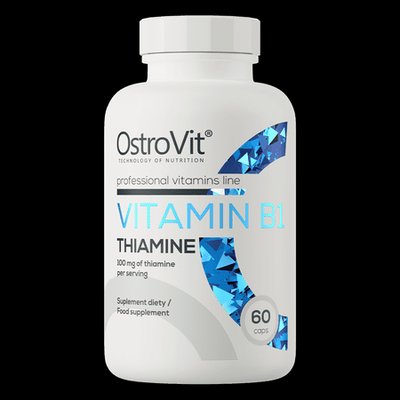 OstroVit Vitamin B1€7.90 In stock Thiamine 60caps are all available. ICONFIT Capsules B-Vitamin Complex N90 is another solid all-in-one option.
Explore the full B vitamin range at maxfit.ee/en/category/b-vitamiin.
Honest Verdict
B vitamins are fundamental to nervous system function, neurotransmitter synthesis, and energy metabolism — all processes relevant to sleep and stress response. The evidence for supplementation improving sleep quality and reducing stress is credible, particularly in people with deficiency or borderline insufficiency, and in those under chronic workplace stress.
For the general population with a varied diet, a standard B-complex is a low-cost, low-risk way to ensure adequacy. Expecting dramatic sleep improvements from B vitamins in already-sufficient individuals is not realistic — but addressing a genuine gap (especially B12 in plant-based eaters) can make a meaningful difference.
FAQ
Can I take B vitamins at night for better sleep?
Not necessarily — and some evidence suggests morning is better. B vitamins, particularly B6 and B12, can influence alertness and energy pathways. Morning supplementation avoids any potential stimulatory effect near bedtime. If vivid dreaming from B6 is desired (as observed in some studies), evening dosing has been used experimentally, but morning is generally safer for sleep quality.
Which B vitamins are most important for stress specifically?
B6, B9 (folate), and B12 are most directly tied to neurotransmitter and mood regulation. B5 has a role in adrenal function. A full B-complex covers all of these, which is why a combination product is often more practical than targeting individual B vitamins.
Is there any risk of taking too much B vitamin complex?
B vitamins are water-soluble, meaning excess is generally excreted in urine rather than stored. At very high sustained doses, B6 in particular can cause peripheral neuropathy. Standard B-complex products at typical doses are considered safe. Avoid mega-dosing individual B vitamins without medical advice.
References
Ebben, M., Lequerica, A., & Spielman, A. (2002). Effects of pyridoxine on dreaming: a preliminary study. Perceptual and Motor Skills, 94(1), 135-140. https://pubmed.ncbi.nlm.nih.gov/11883552/
Stough, C., Scholey, A., Lloyd, J., Spong, J., Myers, S., & Downey, L. A. (2011). The effect of 90 day administration of a high dose vitamin B-complex on work stress. Human Psychopharmacology, 26(7), 470-476. https://pubmed.ncbi.nlm.nih.gov/21905094/
O'Leary, F., & Samman, S. (2010). Vitamin B12 in health and disease. Nutrients, 2(3), 299-316.



