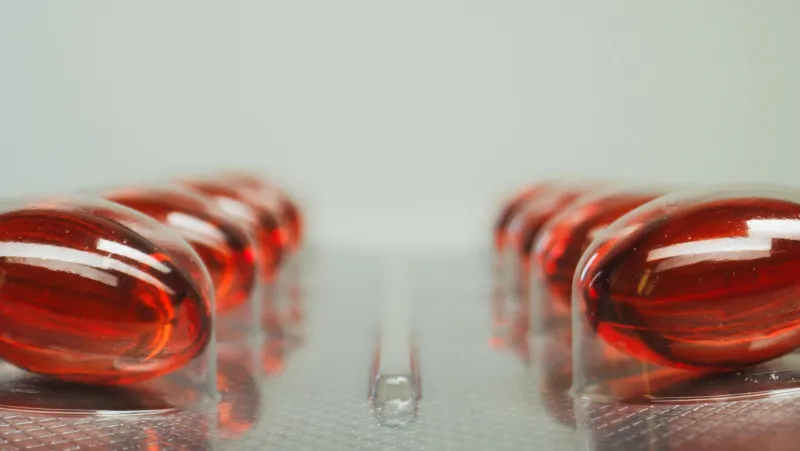
What Is Astaxanthin?
Astaxanthin is a xanthophyll carotenoid — the same family of compounds that gives salmon, shrimp and flamingos their characteristic pink-red colour. It is produced by the microalgae Haematococcus pluvialis under stress conditions — the most concentrated natural astaxanthin source in existence.
Astaxanthin differs fundamentally from other carotenoids: it is not itself degraded into reactive by-products during antioxidant activity (as happens with beta-carotene, for instance). It functions as a "bipolar" antioxidant, capable of working simultaneously on both the outer and inner surfaces of cell membranes.
Antioxidant Potency: Comparison Table
| Antioxidant | Relative Potency (vs. Vitamin C) |
|---|---|
| Vitamin C | 1× |
| Vitamin E | ~5× |
| Coenzyme Q10 | ~15× |
| Lycopene | ~100× |
| Astaxanthin | 6000× |
Astaxanthin's extraordinary antioxidant strength is based on its ability to "quench" singlet oxygen molecules — one of the most damaging reactive oxygen species in biological systems (Naguib, 2000).
Proven Clinical Applications
Skin Health and Anti-Ageing
Astaxanthin is one of the few supplements with double-blind, placebo-controlled evidence for measurable skin improvement:
- Reduced wrinkles and age spots over 8–12 weeks
- Improved skin moisture and elasticity
- Reduced UV-radiation-induced skin damage (Tominaga et al., 2012)
Joint Health
Astaxanthin's anti-inflammatory properties are particularly beneficial for:
- Tennis players, runners and other repetitive-load sports
- Reduces joint pain intensity in observational populations
- Inhibits COX-2 and NF-κB inflammatory pathway activation
Athletic Performance and Recovery
Multiple studies have explored astaxanthin's potential for athletes:
- 4 mg/day for 4 weeks improved strength in endurance runners and reduced lactate accumulation (Ikeuchi et al., 2006)
- Reduced muscle damage markers (creatine kinase) after eccentric training
- Anti-fatigue mechanism: inhibits mitochondrial fatty acid oxidation disruption
Eye Health
Astaxanthin crosses the blood-retinal barrier — a rare property among carotenoids:
- Reduces eye fatigue from prolonged screen use
- Improves visual acuity
- May protect the retina from oxidative stress-induced degeneration (Yasunori et al., 2012)
Source Matters: Natural vs. Synthetic
| Source | Bioactivity | Price |
|---|---|---|
| H. pluvialis microalgae (natural) | High | Higher |
| Synthetic (petrochemical) | Lower | Lower |
| Fish/crustacean source | Moderate | Variable |
Always choose natural-source astaxanthin (labelled "from Haematococcus pluvialis"). Synthetic astaxanthin is cheaper but has lower bioavailability and biological activity.
Dosage and Safety
Recommended doses:
- General antioxidant protection: 4–6 mg/day
- Athletic recovery: 4–12 mg/day
- Skin effects in studies: 4–6 mg/day for 8–16 weeks
- Eye health: 4–6 mg/day
Astaxanthin is fat-soluble — take with a fat-containing meal for optimal absorption.
Safety: Astaxanthin is generally very safe. Very high doses may cause a slight yellowish-orange tint to the skin (carotenodermia) — rare, harmless and reversible. No toxicity has been described in human studies.
References
- Naguib, Y. M. (2000). Antioxidant activities of astaxanthin and related carotenoids. Journal of Agricultural and Food Chemistry, 48(4), 1150–1154.
- Tominaga, K., et al. (2012). Cosmetic benefits of astaxanthin on human subjects. Acta Biochimica Polonica, 59(1), 43–47.
- Ikeuchi, M., et al. (2006). Effects of astaxanthin supplementation on exercise-induced fatigue in mice. Biological and Pharmaceutical Bulletin, 29(10), 2106–2110.
- Yasunori, T., et al. (2012). Eye fatigue improvement through astaxanthin administration. Journal of Clinical Biochemistry and Nutrition, 51(3), 175–182.
- Guerin, M., Huntley, M. E., & Olaizola, M. (2003). Haematococcus astaxanthin: applications for human health and nutrition. Trends in Biotechnology, 21(5), 210–216.
FAQ
How long does astaxanthin take to show effects?
For skin benefits, studies used 8–16-week periods. For athletic recovery, effects may be noticeable within 4–6 weeks. Astaxanthin requires time to accumulate in body tissues — patience is essential.
Why choose natural astaxanthin?
Natural Haematococcus pluvialis astaxanthin is predominantly in ester form, which is more bioavailable and biologically active. Synthetic astaxanthin is mostly in free form, which is less bioactive, and may be derived from petrochemical sources.
Is astaxanthin suitable for vegans?
Yes, if you choose a microalgae (H. pluvialis) based product — it is entirely plant-derived. Astaxanthin sourced from fish or crustaceans is not suitable for vegans.



