
Why Plant-Based Diets May Create Specific Needs
People following vegan or vegetarian diets often make thoughtful choices about nutrient density, stress management, and recovery. While a well-planned plant-based diet meets most nutritional needs, some areas commonly require attention: vitamin B12, iron, omega-3 fatty acids, zinc, and iodine are the most frequently discussed. Stress physiology, sleep quality, and cortisol regulation are less often addressed through supplementation, even though they are just as important for health and performance.
This is where ashwagandha for vegans becomes particularly relevant. Ashwagandha (Withania somnifera) is an adaptogenic plant rooted in Ayurvedic medicine that has been studied in randomised controlled trials for its effects on stress, sleep quality, and physical performance. The root extract is plant-derived, making it inherently compatible with vegan and vegetarian values — provided the product formulation (capsule shell, excipients) is also plant-based.
Vegan-Friendly Ashwagandha Sources
Most standalone ashwagandha supplements use the root extract or a standardised root and leaf extract. The plant origin is vegan by default. The critical check is the capsule shell: traditional capsules use gelatin (bovine- or porcine-derived), while vegan products use hydroxypropyl methylcellulose (HPMC), pullulan, or starch-based shells.
Look for products with explicit "VEGE", "Vegan", or "Vegetarian capsule" labelling:
- OstroVit KSM-66 Ashwagandha VEGE 120caps uses a VEGE capsule and a standardised root extract (KSM-66 is a widely studied proprietary form)
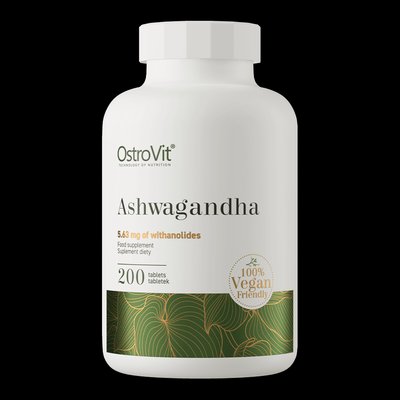 OstroVit Ashwagandha VEGE€10.90 In stock 90tabs and
 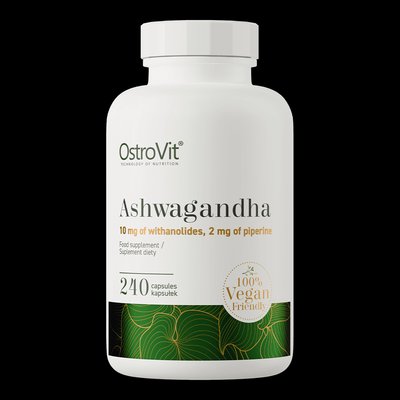 OstroVit Ashwagandha VEGE€13.90 In stock 200 tabs are tablet-based options without gelatin concerns
- OstroVit Ashwagandha VEGE 240caps offers a larger supply in vegan capsule format
- NOW Organic Ashwagandha liquid extract 59ml is a liquid format — check the carrier for vegan suitability, and note it is USDA Organic certified
- NOW Ashwagandha 450mg 90 veg caps uses veg capsules explicitly
Tablet and liquid formats avoid the gelatin question entirely.
Standardised Extracts and Dose Targets
Not all ashwagandha products are equivalent. The potency depends heavily on the extraction method and the level of standardisation. Two well-studied proprietary extracts are:
- KSM-66: a full-spectrum root extract standardised to a specific minimum percentage of withanolides (the active marker compounds). Multiple RCTs have used this form, including Chandrasekhar et al. (2012), who found that KSM-66 supplementation was associated with significantly lower perceived stress scores and serum cortisol levels compared to placebo over an eight-week period.
- Sensoril: a root-and-leaf extract with a different withanolide profile, also with clinical study backing.
Generic ashwagandha root powder without standardisation is less predictable in potency. When a label does not declare withanolide content, you cannot compare it fairly to a standardised extract product.
For most uses, a daily dose of several hundred milligrams of a standardised KSM-66 extract is the range used in clinical research. Product labels should allow you to calculate your intake clearly.
What to Combine with Ashwagandha on a Plant-Based Diet
For vegans and vegetarians specifically, ashwagandha may complement:
- Magnesium: also supports stress regulation and sleep. Commonly suboptimal on plant-based diets due to reduced absorption from phytate-rich plant foods.
- Vitamin B12: not relevant to ashwagandha directly, but critically important for vegans and worth ensuring is covered.
- Zinc: immune function and hormone production; may be lower on plant-heavy diets.
Ashwagandha is not a replacement for any of these micronutrients. It complements a complete diet, not a deficient one.
Choosing a Vegan Ashwagandha Product: Checklist
- Verify the capsule shell — VEGE, HPMC, or vegan notation; or choose tablets/liquid to avoid the question
- Check for standardisation — withanolide percentage or a named extract (KSM-66, Sensoril)
- Declared amount per capsule or serving — avoids guessing
- No proprietary blend that obscures the ashwagandha dose
- Organic certification (optional but preferred by many plant-based consumers) — products like NOW Organic Ashwagandha liquid extract 59ml carry USDA Organic certification
- Third-party testing or GMP certification
All products in the ashwagandha category at maxfit.ee are browsable by format and brand, making it straightforward to compare vegan-suitable options.
FAQ
Is all ashwagandha suitable for vegans?
The plant itself is vegan. Whether the product is vegan depends on the formulation. The key concern is the capsule shell. Look for products labelled VEGE, vegetarian, or vegan capsules — or choose tablet and powder formats, which avoid the issue entirely.
How long does ashwagandha take to produce noticeable effects?
In clinical studies, ashwagandha is typically assessed after six to eight weeks of consistent daily use. Chandrasekhar et al. (2012) used an eight-week protocol. Effects on stress and sleep quality are not immediate — they build gradually with consistent use. Do not evaluate a product after only a few days.
Can I take ashwagandha with melatonin or other sleep supplements?
Ashwagandha and melatonin have different mechanisms of action and are commonly taken together without reported interaction concerns in the research literature. Ashwagandha acts on the stress-cortisol axis and HPA regulation, while melatonin directly influences circadian rhythm and sleep onset. Combining them is reasonable for a comprehensive sleep-support approach, but is not necessary — ashwagandha alone has been studied for sleep quality outcomes.
References
Chandrasekhar, K., Kapoor, J., & Anishetty, S. (2012). A prospective, randomized double-blind, placebo-controlled study of safety and efficacy of a high-concentration full-spectrum extract of ashwagandha root in reducing stress and anxiety in adults. Indian Journal of Psychological Medicine, 34(3), 255-262. https://pubmed.ncbi.nlm.nih.gov/23439798/
Choudhary, D., Bhattacharyya, S., & Joshi, K. (2017). Body weight management in adults under chronic stress through treatment with ashwagandha root extract: a double-blind, randomized, placebo-controlled trial. Journal of Evidence-Based Complementary and Alternative Medicine, 22(1), 96-106. https://pubmed.ncbi.nlm.nih.gov/27055824/
Wankhede, S., Langade, D., Joshi, K., Sinha, S. R., & Bhattacharyya, S. (2015). Examining the effect of Withania somnifera supplementation on muscle strength and recovery: a randomized controlled trial. Journal of the International Society of Sports Nutrition, 12, 43. https://pubmed.ncbi.nlm.nih.gov/26609282/



