What to Stack with Ashwagandha: Synergies and Conflicts
Ashwagandha (Withania somnifera) is one of the most widely used adaptogens in sports nutrition. It is best known for its effects on stress adaptation, testosterone support in men, and potential improvements in strength and recovery. However, ashwagandha stacking — combining it with other supplements — is not always straightforward. Understanding which combinations are synergistic, which are neutral, and which are antagonistic helps you get more from your supplement protocol without unnecessary risk.
Evidence-Based Synergies
Ashwagandha + Creatine (Strength and recovery)
One of the best-supported stacks. A randomised controlled trial by Wankhede et al. (2015) showed that ashwagandha root extract combined with resistance training produced significant improvements in muscle strength and recovery markers compared to placebo. Creatine independently enhances high-intensity performance. Both compounds support lean mass development through complementary mechanisms — creatine by enhancing ATP regeneration, ashwagandha by modulating cortisol and supporting testosterone levels.
Ashwagandha + Magnesium (Sleep and stress)
Both compounds are associated with improvements in sleep quality and reductions in physiological stress markers. Ashwagandha's adaptogenic effects and magnesium's role in GABA receptor function and HPA axis regulation create a plausible mechanistic synergy. Neither competing for absorption pathways nor blocking each other's effects, this combination is widely regarded as safe and complementary.
Ashwagandha + Vitamin D (Hormonal support)
Vitamin D deficiency is associated with suppressed testosterone levels. Ashwagandha's testosterone-supporting effects may compound with adequate vitamin D status. In northern countries like Estonia, vitamin D deficiency is common, making this combination particularly relevant.
Antagonistic Combinations
Ashwagandha + Stimulants (Caffeine, high-dose pre-workout)
Ashwagandha modulates the stress response downward — reducing cortisol and adrenergic activity. High-dose caffeine and pre-workout complexes act in the opposite direction, stimulating the HPA axis and increasing cortisol and adrenaline. Taking both together may partially cancel each other's effects. More importantly, ashwagandha's calming effect may blunt the intended stimulant response of a pre-workout, making the combination inefficient rather than dangerous.
Ashwagandha + Sedative medications / supplements (caution, not contraindication)
Ashwagandha has mild GABAergic properties and may enhance the effect of sedatives, sleep aids (melatonin at high doses), and benzodiazepines. If you are on prescription sedatives, consult a healthcare professional before combining.
Ashwagandha + Thyroid medications
Ashwagandha has shown effects on thyroid hormone levels in some studies. Those on thyroid medication should use caution and monitor thyroid panel values regularly.
Timing Within a Stack
| Supplement | Recommended timing with ashwagandha |
|---|---|
| Creatine | Both can be taken at any time; morning or post-workout works well |
| Magnesium | Both work well together at night (supports sleep) |
| Vitamin D | Take with a fat-containing meal; morning or midday |
| Caffeine / pre-workout | Separate by at least 4–6 hours; ashwagandha in the evening |
| Melatonin | Can stack at night; monitor for excessive sedation |
Ashwagandha itself is somewhat flexible in timing. Many users find evening dosing most beneficial for sleep quality and cortisol management. If using for athletic performance, consistent daily dosing matters more than exact timing.
Sample Stacks by Goal
Stress reduction and sleep quality
- Ashwagandha (evening) + Magnesium (evening) + Vitamin D (morning)
Strength and body composition
- Ashwagandha (morning or evening) + Creatine (any time, consistent daily) + Vitamin D (morning)
General wellness in a Northern climate (winter)
- Ashwagandha + Vitamin D + Omega-3 + Magnesium (fill the most common northern deficiencies while supporting adaptation)
What to Avoid
- Do not stack ashwagandha with other adaptogens (Rhodiola, Panax ginseng) without specific reason — the interaction is not well studied and the combined sedative/stimulant effects are unpredictable
- Avoid taking ashwagandha immediately with large doses of stimulants — the combination may reduce net benefit from both
- Do not use ashwagandha during pregnancy without explicit medical advice; animal studies raise caution
At maxfit.ee you can find a range of ashwagandha products including ICONFIT Capsules Ashwagandha N90, OstroVit KSM-66 Ashwagandha VEGE 120caps, and 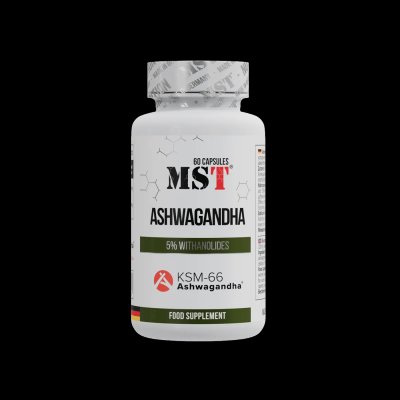 MST Ashwagandha KSM66€16.90 In stock 60caps. KSM-66 is a clinically studied, high-concentration root extract. NOW Ashwagandha 450mg 90 veg caps is another solid option for those preferring a simpler formula.
FAQ
Can I take ashwagandha every day long-term?
Most studies use daily supplementation for 8–12 weeks. Long-term safety data beyond 6 months in controlled trials is limited, but ashwagandha has a long history of traditional use without documented serious adverse effects at standard doses. Cycling (e.g., 8 weeks on, 2 weeks off) is a common practical approach.
How long does ashwagandha take to work?
Stress and sleep effects are typically reported within 2–4 weeks of consistent daily use. Strength and body composition effects studied by Wankhede et al. (2015) emerged over 8 weeks of combined training.
Is ashwagandha suitable for women?
Yes. While most mechanistic studies on testosterone have focused on men, women also experience cortisol-lowering, sleep, and recovery benefits. Women who are pregnant or planning pregnancy should consult a healthcare provider before use.
References
Wankhede, S., Langade, D., Joshi, K., Sinha, S. R., & Bhattacharyya, S. (2015). Examining the effect of Withania somnifera supplementation on muscle strength and recovery: a randomized controlled trial. Journal of the International Society of Sports Nutrition, 12(1), 43. https://pubmed.ncbi.nlm.nih.gov/26609282/
Choudhary, D., Bhattacharyya, S., & Joshi, K. (2017). Body weight management in adults under chronic stress through treatment with ashwagandha root extract. Journal of Evidence-Based Complementary & Alternative Medicine, 22(1), 96-106. https://pubmed.ncbi.nlm.nih.gov/27055824/



