
What Is Ashwagandha and Why Do Food Sources Matter?
Ashwagandha (Withania somnifera) is an adaptogenic herb whose root contains bioactive withanolides. Unlike vitamins that are distributed across many common foods, ashwagandha withanolides exist almost exclusively in the plant itself — making "ashwagandha food sources" a very short list.
Top Food Sources of Ashwagandha
The honest answer is that ashwagandha is not a common dietary food. It is a medicinal root native to India, North Africa, and the Mediterranean. Its presence in regular Western diets is essentially zero unless added intentionally.
The realistic ways to encounter ashwagandha in food form include:
- Ashwagandha root powder mixed into warm milk (a traditional Ayurvedic preparation called ashwagandha doodh)
- Fortified foods and functional beverages — some health-food products add ashwagandha powder or extract
- Herbal teas containing dried ashwagandha root
- Adaptogen blends added to protein shakes or smoothie mixes
None of these are conventional grocery staples. You will not encounter meaningful withanolide content in standard fruits, vegetables, grains, or animal products.
Bioavailability: Food Form vs Supplement
Research on ashwagandha bioavailability has focused almost entirely on standardised root extracts rather than whole-food preparations. A crossover study found that a concentrated root extract standardised to withanolides produced measurable plasma levels and functional effects on stress and cortisol (Chandrasekhar et al., 2012). Whether the same dose in loose powder form achieves equivalent plasma levels depends on the withanolide concentration of the powder, which varies widely.
Key points:
- Withanolide content is the driver — raw root powder typically contains far lower withanolide percentages than standardised KSM-66 or Sensoril extracts
- Fat-soluble nature of withanolides means taking ashwagandha with a small amount of fat (e.g., in warm milk or with a meal) may support absorption
- Processing and storage degrade withanolides; dried and stored root powder loses potency over time
Daily Targets and What You Get From Diet
Clinical trials on stress, anxiety, and physical performance have used daily doses of concentrated extract. At these levels, obtaining a comparable withanolide amount from food would require consuming substantial quantities of raw root powder daily — an impractical amount in culinary use.
For most people in Estonia and Northern Europe, ashwagandha simply does not appear in the diet at all. There is no established dietary reference intake because it is not classified as a nutrient but as a botanical.
Cooking and Storage Effects
Heat processing affects withanolide stability. Traditional preparations often involve boiling the root in milk, which may partially reduce withanolide content. Freeze-dried or cold-processed extracts are designed to preserve the active compounds. If you do use ashwagandha root powder in cooking:
- Avoid prolonged boiling — simmering briefly is preferable
- Store in a cool, dark, sealed container away from moisture
- Check the manufacture date — older powder may have significantly lower active content
When Food Sources Are Not Enough
Given that ashwagandha is absent from the standard diet and that therapeutic effects have been demonstrated with standardised extracts, food sources alone are not a realistic strategy for most people. Supplementation with a well-characterised root extract is the only practical way to achieve consistent withanolide intake.
At maxfit.ee, you can find several high-quality ashwagandha supplements. ICONFIT Capsules Ashwagandha N90 provides a convenient daily dose in capsule form. OstroVit KSM-66 Ashwagandha VEGE 120caps uses the well-studied KSM-66 extract standardised for withanolide content. 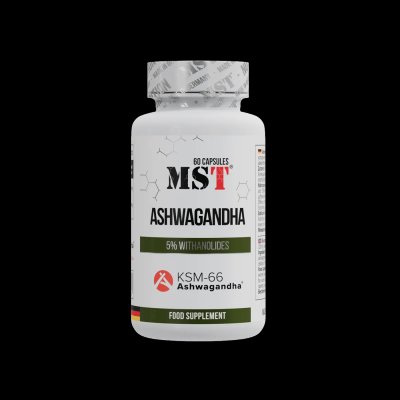 MST Ashwagandha KSM66€16.90 In stock 60caps is another KSM-66 option for those wanting a smaller pack size. NOW Ashwagandha 450mg 90 veg caps offers a vegan-friendly choice.
Who Should Consider Supplementing?
- Individuals under chronic psychological stress
- Athletes looking to support recovery
- People with disrupted sleep patterns who prefer non-pharmaceutical options
- Those in high-pressure work environments — stress is common in modern life across all demographics
Always consult a healthcare professional before starting any supplement, particularly if you take thyroid medication, immunosuppressants, or sedatives, as interactions have been reported.
FAQ
Does ashwagandha occur naturally in any common foods?
No. Withanolides — the active compounds in ashwagandha — are found almost exclusively in Withania somnifera root and leaves. They are not present in everyday foods like vegetables, fruits, grains, or animal products.
Can I get the same effect from ashwagandha tea as from capsules?
Herbal teas made from dried root contain withanolides, but the concentration is typically much lower and less consistent than standardised extracts. If you enjoy the ritual of tea, it may provide mild benefit, but for studied effects on stress or physical performance, standardised extracts are the evidence-based choice.
Is ashwagandha safe to take every day?
Short-to-medium-term daily use of ashwagandha root extract appears well tolerated in healthy adults (Pratte et al., 2014). Long-term safety data beyond 12 weeks is limited. Periodic breaks are a common precautionary practice.
References
Chandrasekhar, K., Kapoor, J., & Anishetty, S. (2012). A prospective, randomized double-blind, placebo-controlled study of safety and efficacy of a high-concentration full-spectrum extract of ashwagandha root in reducing stress and anxiety in adults. Indian Journal of Psychological Medicine, 34(3), 255-262. https://pubmed.ncbi.nlm.nih.gov/23439798/
Pratte, M. A., Nanavati, K. B., Young, V., & Morley, C. P. (2014). An alternative treatment for anxiety: A systematic review of human trial results reported for the Ayurvedic herb ashwagandha (Withania somnifera). Journal of Alternative and Complementary Medicine, 20(12), 901-908. https://pubmed.ncbi.nlm.nih.gov/25405876/
Singh, N., Bhalla, M., de Jager, P., & Gilca, M. (2011). An overview on ashwagandha: A rasayana (rejuvenator) of Ayurveda. African Journal of Traditional, Complementary and Alternative Medicines, 8(5 Suppl), 208-213. https://doi.org/10.4314/ajtcam.v8i5s.9



