What Is Alpha-Lipoic Acid and Why Quality Matters
Alpha-lipoic acid (ALA) is a naturally occurring compound that acts as a cofactor in mitochondrial energy metabolism and functions as both a water-soluble and fat-soluble antioxidant. It is produced in small amounts by the body and is also found in foods such as spinach, broccoli, and organ meats. As a supplement, alpha-lipoic acid (ALA) quality varies enormously — and the differences have practical consequences for how well it works in your body.
Unlike vitamins that have well-established international quality standards, the ALA supplement market is largely unregulated. Understanding what to look for can save you from wasting money on a product that delivers little benefit.
What to Look for on the Label
The first thing to check is the declared form. ALA exists in two mirror-image molecular forms: the R-form (R-ALA) and the S-form (S-ALA). Most synthetic ALA supplements contain a 50/50 mixture called racemic ALA. The R-form is the naturally occurring enantiomer that the body uses; a label that lists only "alpha lipoic acid" without specifying the form almost certainly contains racemic ALA.
Look also at the actual active ingredient amount per capsule or serving. Some products pad their capsules with fillers, so the stated weight per capsule may be much higher than the actual ALA content. A transparent label lists the ALA amount separately from other excipients.
Check the list of other ingredients for unnecessary additives: artificial colours, proprietary blends that hide individual doses, and unlisted anti-caking agents. A short, clean ingredient list is a positive signal.
Form and Dose Markers
R-ALA is more bioavailable than racemic ALA (Streeper et al., 1997). However, pure R-ALA is less shelf-stable than racemic ALA and can degrade when exposed to heat or moisture. Manufacturers sometimes stabilise it as sodium R-lipoate or as a potassium salt, which improves stability without meaningfully reducing bioavailability.
If you choose racemic ALA, look for products in the range used in clinical research — studies on insulin sensitivity and oxidative stress typically used doses between 300 mg and 600 mg per day (Golbidi et al., 2011). If you choose R-ALA, similar biological effects may be seen at roughly half the dose because only the R-form is biologically active in racemic ALA.
Capsules are generally preferred over tablets, as enteric coatings on tablets may alter absorption timing. Time-release formulations exist but the clinical evidence for their advantage over standard capsules is limited.
Third-Party Testing
Because the supplement industry is only partially regulated, third-party testing is one of the strongest quality signals available. Look for certification from organisations such as NSF International, Informed Sport, or USP. These bodies test for label accuracy (does the product actually contain what it claims?), contamination with heavy metals or pesticides, and the absence of banned substances.
Products tested by these programmes display a seal on the label or their website. If you cannot find any third-party certification information after a brief search, that does not automatically mean the product is poor — but it is a missing quality signal.
Some reputable brands publish certificates of analysis (COAs) from independent laboratories on their websites. A COA showing the actual measured ALA content per batch is a strong transparency indicator.
Red Flags to Avoid
Several patterns predict a lower-quality product. Avoid supplements that:
- Make disease-treatment claims on the label (these are not permitted and indicate the brand ignores regulatory guidelines)
- Do not list the ALA content per serving clearly
- Are priced dramatically below comparable products without explaining why
- Come from a brand with no verifiable quality certifications and no published COAs
- List a dose far outside the range used in peer-reviewed research without explanation
Be sceptical of products combining ALA with many other antioxidants at very low individual doses. While combination products exist, they often deliver sub-therapeutic amounts of each ingredient.
Value for Money
Higher price does not always equal higher quality, but extremely cheap ALA supplements are a warning sign. R-ALA raw material is genuinely more expensive to produce than racemic ALA, so a product claiming to be pure R-ALA at the same price as racemic products warrants scrutiny.
Compare cost per gram of active ALA, not cost per capsule. A product offering 600 mg per capsule may appear more expensive per unit but is cheaper per gram of ALA than one offering 200 mg per capsule at a similar price.
At maxfit.ee you can find established ALA supplements from brands with published product specifications. 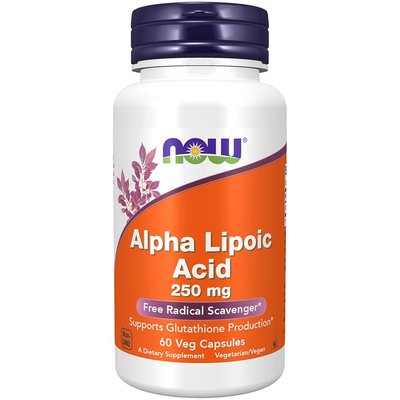 NOW Alpha Lipoic Acid€17.90 In stock 250mg 60 veg caps and NOW Alpha Lipoic Acid 100mg 60 veg caps are well-documented options from a brand with a long track record of third-party testing. MST Alpha Lipoic Acid 200mg + vitamin C 60caps combines ALA with vitamin C, which shares antioxidant-recycling pathways.
For the full range of available alpha-lipoic acid supplements, compare label details and select the form and dose that fits your goals.
FAQ
What is the difference between R-ALA and racemic ALA?
R-ALA is the naturally occurring enantiomer of alpha-lipoic acid that the body uses in metabolic processes. Racemic ALA is a 50/50 mix of R-ALA and S-ALA. R-ALA has greater bioavailability (Streeper et al., 1997), meaning you may need a lower dose to achieve a similar effect, though it is also less stable and typically more expensive.
Is alpha-lipoic acid safe for everyone?
ALA is generally well tolerated at commonly used doses. Individuals taking diabetes medications should be aware that ALA may enhance glucose uptake and could interact with their treatment — always consult a healthcare professional before adding any supplement if you are on medication.
Does ALA need to be taken with food?
Some people experience mild gastrointestinal discomfort when taking ALA on an empty stomach. Taking it with a small meal or snack can reduce this. There is no strong evidence that food significantly alters ALA absorption, so choose whichever approach is most comfortable for you.
References
Streeper, R. S., Henriksen, E. J., Jacob, S., Hokama, J. Y., Fogt, D. L., & Tritschler, H. J. (1997). Differential effects of lipoic acid stereoisomers on glucose metabolism in insulin-resistant skeletal muscle. American Journal of Physiology, 273(1), E185-E191. https://pubmed.ncbi.nlm.nih.gov/9252495/
Golbidi, S., Badran, M., & Laher, I. (2011). Diabetes and alpha lipoic acid. Frontiers in Pharmacology, 2, 69. https://pubmed.ncbi.nlm.nih.gov/22125537/



